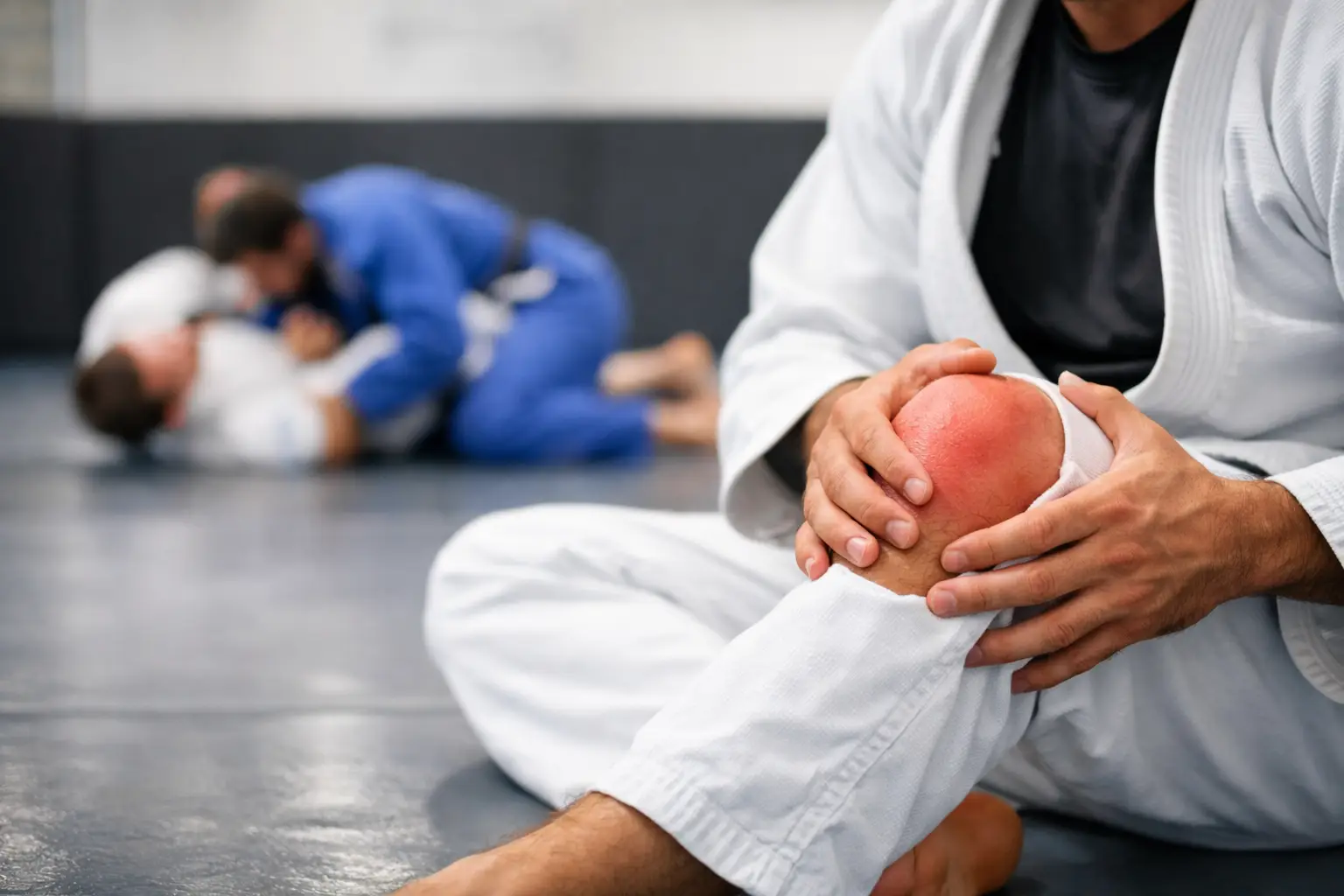
A knee that feels fine walking into class can start barking halfway through guard rounds. You shoot a takedown, post on a bent leg, get your knee line twisted in a scramble, and suddenly every technical stand-up is a reminder. If you are asking, why do BJJ knees hurt, the answer is usually not one bad movement. It is the accumulated effect of BJJ positions, training volume, tissue capacity, and the way you prepare between sessions.
BJJ places the knee in situations that are hard to replicate with a standard gym routine. Deep flexion, rotation under load, pressure from kneeling, explosive level changes, and unpredictable resistance all show up in the same class. The goal is not to avoid those demands. It is to build a body that can handle them while recognizing when pain is asking for a change.
Why Do BJJ Knees Hurt? The Main Reasons
Your knee is not a simple hinge. It has to bend, stabilize, transfer force between the hip and foot, and tolerate some rotation during grappling. Pain often develops when the joint and surrounding tissues are repeatedly asked to absorb more force than they are currently prepared to manage.
Rotational stress in scrambles and guard exchanges
BJJ creates rotational forces when your foot is planted but your body keeps moving. Think of defending a single leg, trying to turn out of a knee-cut pass, or posting a foot during a scramble while your partner controls your hips. The knee may be caught between the direction your foot is fixed and the direction your torso is being pulled.
This does not mean rotation is inherently dangerous. Your knee needs some rotational capacity. The problem is uncontrolled rotation under fatigue, especially when it happens suddenly or repeatedly. Grapplers with limited hip mobility, poor single-leg control, or weak hamstrings often ask the knee to solve a problem that should be shared by the entire lower body.
Deep knee flexion and kneeling pressure
Closed guard, seated guard, turtle, shots, and long stretches of drilling from the knees all require significant knee bend. Some athletes tolerate deep flexion well. Others feel pressure at the front of the knee, around the kneecap, particularly when training volume rises quickly.
Direct contact matters too. A hard mat, repeated knee-walking, and a partner's weight on the knee can irritate sensitive structures even when there is no major injury. Knee pads may reduce direct compression, but they will not fix a strength or workload problem. Use them when kneeling aggravates symptoms, while also addressing the reason your knee is becoming reactive.
Weakness is rarely the whole story, but capacity matters
A painful knee is not automatically a weak knee. Still, lower-body strength and control strongly influence how well you tolerate mat demands. The quads absorb force in shots and stand-ups. The hamstrings help stabilize the knee during changes of direction. The glutes control the femur and pelvis when you post, sprawl, or drive through a takedown.
When those systems lack capacity, the knee often becomes the loudest link in the chain. This is especially common when someone trains hard on the mats but treats strength work as optional, random, or too exhausting to perform consistently.
Sudden spikes in training load
Many knee issues begin after a change in workload, not a single dramatic event. You add open mat on Sunday, start drilling takedowns twice a week, prepare for a tournament, or return from time away and try to match your old pace immediately. Your skill may return faster than your tissues adapt.
A good rule is simple: soreness that settles and does not alter your movement is different from pain that builds each session, changes how you roll, or lingers into daily activities. Your knees need exposure to load, but they need progressive exposure.
Technique and positional habits
Some discomfort is tied to the positions you repeatedly choose. Forcing a deep knee angle to retain guard, driving the knee inward during stand-ups, or wrestling through a compromised base can create a predictable pain pattern. Technique is not separate from physical preparation. Better movement options make better technical choices available under pressure.
If a certain movement hurts every time, do not simply push through it because it is common in class. Adjust the position, reduce the range, choose a different entry, or tell your training partner what is going on. Smart adaptation keeps you training instead of turning a manageable issue into forced time off.
Where the Pain Shows Up Can Offer Clues
The location of your knee pain does not provide a complete diagnosis, but it can guide the conversation with a qualified clinician and help you track patterns. Pain at the front of the knee is often aggravated by kneeling, stairs, prolonged deep flexion, and repeated shots. Pain on the inside can show up after twisting, valgus stress, or hard pressure during passing exchanges. Pain on the outside may be linked to lateral pressure, rotational positions, or poor control up the chain at the hip.
Pain that feels deep inside the joint, includes catching or locking, or follows a distinct pop and swelling deserves more caution. Do not diagnose yourself from a pain location chart. Instead, record what happened, which positions provoke it, whether swelling appears, and how the knee responds over the next 24 hours.
Red Flags That Should Change Your Plan
Most training-related knee pain is not an emergency, but some symptoms are not a “keep rolling and see” situation. Stop training and seek medical evaluation promptly if you cannot bear weight, the knee gives way repeatedly, swelling comes on quickly after a specific incident, or you cannot fully bend or straighten it.
A pop followed by swelling, joint locking, numbness, visible deformity, fever, or a hot and severely swollen joint also warrants urgent assessment. For pain that persists, recurs, or steadily worsens despite sensible training modifications, work with a sports medicine professional or physical therapist who understands grappling demands.
Getting help early is not soft. It is how serious athletes protect their training runway.
Build Knees That Hold Up on the Mat
The most useful approach is not chasing a single magic exercise. Build a lower body that can produce force, absorb force, and stay organized when positions get messy. Your programming should match your current symptoms, mat schedule, experience level, and competition goals.
Start with controlled strength through ranges you can tolerate. Split squats, step-ups, squats to a comfortable depth, and sled work can develop quad capacity without requiring reckless loading. Romanian deadlifts, hip hinges, hamstring curls, and bridges build posterior-chain strength that supports takedown defense and scrambling.
Single-leg work deserves a permanent place in a grappler's plan. A stable split squat, single-leg Romanian deadlift, or controlled lateral step-down teaches the hip, knee, and foot to manage force together. Begin with a range and load that produces quality reps. Progression comes from consistency, not from turning every set into a test.
Do not ignore the calves and feet. Strong calves help control the ankle and transmit force when you drive, post, shoot, or change direction. Calf raises, tibialis work, and balanced foot-strength training are small investments that support the entire lower-body system.
Train rotation with control, not chaos
You cannot make BJJ rotationally simple, so your preparation should not be entirely straight-line. Controlled lateral lunges, cossack squat variations, rotational hip work, and deceleration drills can improve movement options around the knee. The priority is control at first. If you cannot own a slow lateral movement, adding faster cutting and reactive drills is usually premature.
This is where a BJJ-specific strength plan earns its value. A generic leg day may make you tired without preparing you for posts, level changes, sprawls, or off-angle pressure. MatFlow organizes strength and conditioning around those on-mat realities, with personalized adjustments when your knee needs a different exercise, range, or training phase.
Adjust Mat Training Without Losing Momentum
Pain does not always require a complete shutdown. It often requires better constraints. If kneeling hurts, reduce long kneeling drills and use padding where appropriate. If twisting is provocative, limit high-speed scrambles and choose positional rounds that keep you out of repeated unstable entries. If hard takedown rounds trigger symptoms, drill cleaner setups at a lower intensity while building your lower-body capacity off the mat.
Communicate with your coach and partners. A good room can help you avoid reckless leg entanglements, explosive takedown exchanges, or pressure-heavy positions for a short period. You can still improve timing, grips, upper-body offense, guard retention concepts, and conditioning while the knee settles.
Recovery also has to be part of the plan. Sleep, nutrition, and spacing hard sessions affect how well tissue tolerates load. Two punishing leg sessions on top of five intense BJJ classes may be productive for one athlete and excessive for another. The right amount depends on your training age, bodyweight, injury history, current stress, and how hard your actual rounds are.
Use Pain as Feedback, Not a Character Test
BJJ rewards toughness, but toughness without decision-making is expensive. Track the movement that hurts, the intensity of the pain, your next-day response, and whether your knee is improving week to week. That data is more useful than guessing or copying the training volume of the healthiest person in the room.
Your knees do not need perfect conditions. They need intelligent exposure, stronger support from the hips to the feet, and enough recovery to adapt. Train with that standard, and you give yourself a better chance to stay on the mat, build explosive power, and keep progressing long after the short-term pain would have pushed other grapplers out of training.