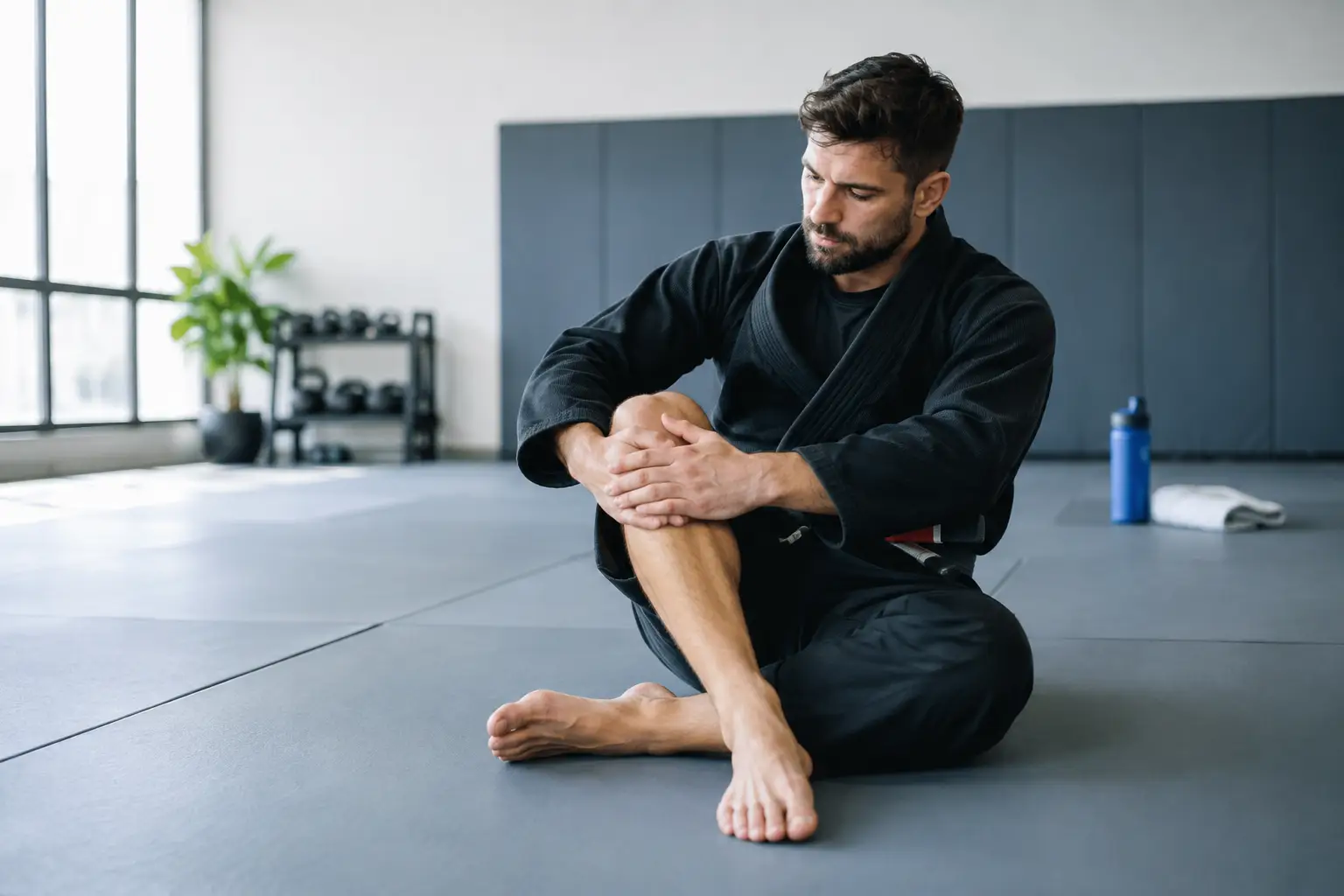
A sore shoulder after a hard kimura defense is one thing. A shoulder that hurts when you frame, post, press, or sleep is a training decision. The goal when you train around BJJ injuries is not to prove toughness by ignoring pain. It is to preserve the physical qualities that keep you dangerous on the mat while giving irritated tissue the right conditions to recover.
For most grapplers, complete shutdown is not the only option. But neither is training normally with a few extra painkillers. Smart adjustment lets you maintain strength, mat endurance, movement capacity, and confidence without repeatedly loading the exact pattern that is keeping you hurt.
Start With the Right Training Decision
An injury-aware plan starts by separating discomfort from a meaningful warning sign. General muscular soreness, stiffness that improves during warm-up, and fatigue after a hard week may call for a lighter session. Sharp pain, joint instability, swelling, numbness, loss of strength, pain that changes how you move, or symptoms that worsen after training deserve a more conservative response and, when appropriate, an evaluation from a qualified medical professional.
Do not use training to diagnose an injury. If you cannot bear weight, cannot use a limb normally, suspect a fracture or significant tear, or have neurological symptoms, get medical care before trying to program around it.
For less severe, already assessed limitations, use a simple filter: can you train the movement without pain increasing during the session, changing your mechanics, or flaring up later that day or the next morning? If the answer is no, that movement is not currently earning its place in your program.
This does not mean the entire body is off limits. A painful elbow may limit pulling volume and gripping but leave lower-body strength, trunk work, aerobic conditioning, and certain unilateral exercises available. A cranky knee may change your squat depth and rolling intensity while allowing upper-body strength and low-impact conditioning. Your job is to identify what is limited, what is tolerated, and what still moves your overall performance forward.
How to Train Around BJJ Injuries Without Going Passive
The best modifications protect the irritated area while keeping the training stimulus specific enough to matter. That requires more thought than simply replacing every exercise with machines or doing random mobility circuits.
First, reduce the aggravating variable. It could be range of motion, load, speed, volume, grip demand, instability, or compression. A shoulder may tolerate a neutral-grip floor press but not a deep dumbbell bench press. An irritated knee may tolerate a controlled box squat but not high-rep jumping or deep knee-flexion work. A finger injury may handle straps on a row better than hard gi gripping.
Then keep the closest useful pattern. If conventional deadlifts irritate your back, a trap-bar variation from blocks, hip thrusts, or single-leg work may preserve lower-body strength with a different loading profile. If push-ups hurt a wrist, elevated push-ups on handles or neutral-grip dumbbell pressing may let you train horizontal pressing without forcing extension through the wrist.
Finally, control the dose. Even a pain-free variation can become a problem when you turn it into a high-volume test. Start with conservative sets, leave repetitions in reserve, and monitor the response over the following 24 hours. A session that feels fine in the moment but creates a major flare-up the next day was too much training stress.
Adjust One Variable at a Time
Grapplers often make the mistake of changing everything at once. They reduce rolling, switch exercises, add rehab drills, start running, and increase mobility work in the same week. When symptoms improve or worsen, they have no idea why.
Change the most likely aggravator first. If hard rounds are making your rib injury worse, reduce sparring intensity or positional situations before rebuilding your whole strength program. If pulling aggravates medial elbow pain, lower grip-heavy pulling volume and choose a more joint-friendly handle before eliminating all upper-body work.
This approach also prevents detraining. You want the smallest effective adjustment, not an unnecessarily broad retreat from training.
Keep Building the Qualities BJJ Still Demands
An injury does not erase the need for explosive power, positional strength, tissue resilience, and mat endurance. It changes how you develop them for a period of time.
Lower-body limitations can be an opportunity to emphasize upper-body strength, trunk control, breathing mechanics, and conditioning that does not aggravate the issue. Upper-body injuries may create room for unilateral leg training, sled work if tolerated, controlled cycling, and hip-dominant strength. When impact is a problem, low-impact aerobic work can maintain a valuable base for recovery between rounds.
The trunk deserves special attention because it transfers force during takedowns, guard retention, scrambling, and pressure passing. But choose exercises based on the injury. Heavy sit-ups may be a poor choice with a rib or hip-flexor issue, while controlled anti-rotation or anti-extension work may be more tolerable. With a low-back flare-up, aggressive twisting and fatigue-based trunk training may need to wait, but bracing drills, carries, and carefully selected isometrics can sometimes remain useful.
Isometrics are particularly valuable when dynamic movement is painful or poorly controlled. Holding a split squat, a supported row position, or a modified push-up position can maintain tension with less movement through an irritated joint. They are not a universal fix, but they can be an effective bridge between rest and full loading.
Modify Your Mat Training, Not Just the Gym Work
Strength training is only one part of the stress equation. If you modify your lifts but still fight out of every bad position in class, the injury will keep receiving the same signal.
Tell your coach and training partners what is limited. You do not need a dramatic announcement. A direct conversation helps you avoid uncontrolled situations, accidental attacks on the injured area, and the pressure to win rounds that should be technical.
Choose positions with intent. A painful shoulder may mean avoiding heavy posting, explosive sprawls, and repeated overhead framing. A knee issue may require less stand-up volume, fewer deep flexion positions, or controlled guard work instead of chaotic scrambles. A finger injury may be the right time to prioritize no-gi grips, open-hand control, and positional movement rather than death-gripping the gi.
Technical rounds can still develop timing, decision-making, and efficient movement. Positional sparring with clear rules often provides better injury control than open rounds, where fatigue and ego make your body pay for bad decisions.
Use Pain as Data, Not a Challenge
Pain monitoring does not have to become obsessive. Before training, rate your symptoms and note what movements are restricted. During training, watch for sharp pain, compensation, or a rising pain level. Afterward, assess whether symptoms settle back to baseline within a reasonable window.
A useful rule is that pain should not steadily climb through the session, force you to alter technique, or leave you substantially worse the next day. If it does, reduce the range, load, repetitions, or sport exposure next time. If symptoms repeatedly flare despite sensible changes, you need more assessment rather than more willpower.
Recovery also matters more during this phase. Sleep, protein intake, total training volume, and stress management will not magically repair every injury, but poor recovery makes it harder to tolerate the work you can still do. The athlete who cuts sleep while trying to compensate for missed rolling with extra gym sessions usually extends the problem.
Build a Return Plan Before You Feel 100 Percent
Returning to normal training should be a progression, not a single green light. Reintroduce the specific demands that caused trouble in layers: controlled strength work, fuller ranges of motion, moderate speed, technical drilling, positional resistance, then harder rounds and competition-level intensity.
This is where tracking becomes valuable. Record the exercise variation, load, range of motion, sets, reps, rolling intensity, and next-day response. Patterns become visible quickly. You may find that your shoulder tolerates pressing twice per week but not three times, or that your knee handles drilling but flares after hard takedown rounds.
MatFlow is built around this kind of adjustment, helping grapplers adapt exercise selection, training phases, and workout volume without losing sight of BJJ performance. The point is not to follow a generic injury workout. It is to keep making measurable progress with the body you have on a given week.
Training around an injury is a skill serious grapplers develop over time. Respect the limitation, keep loading what you can safely train, and return to full intensity only when your body has shown it can handle the next step.