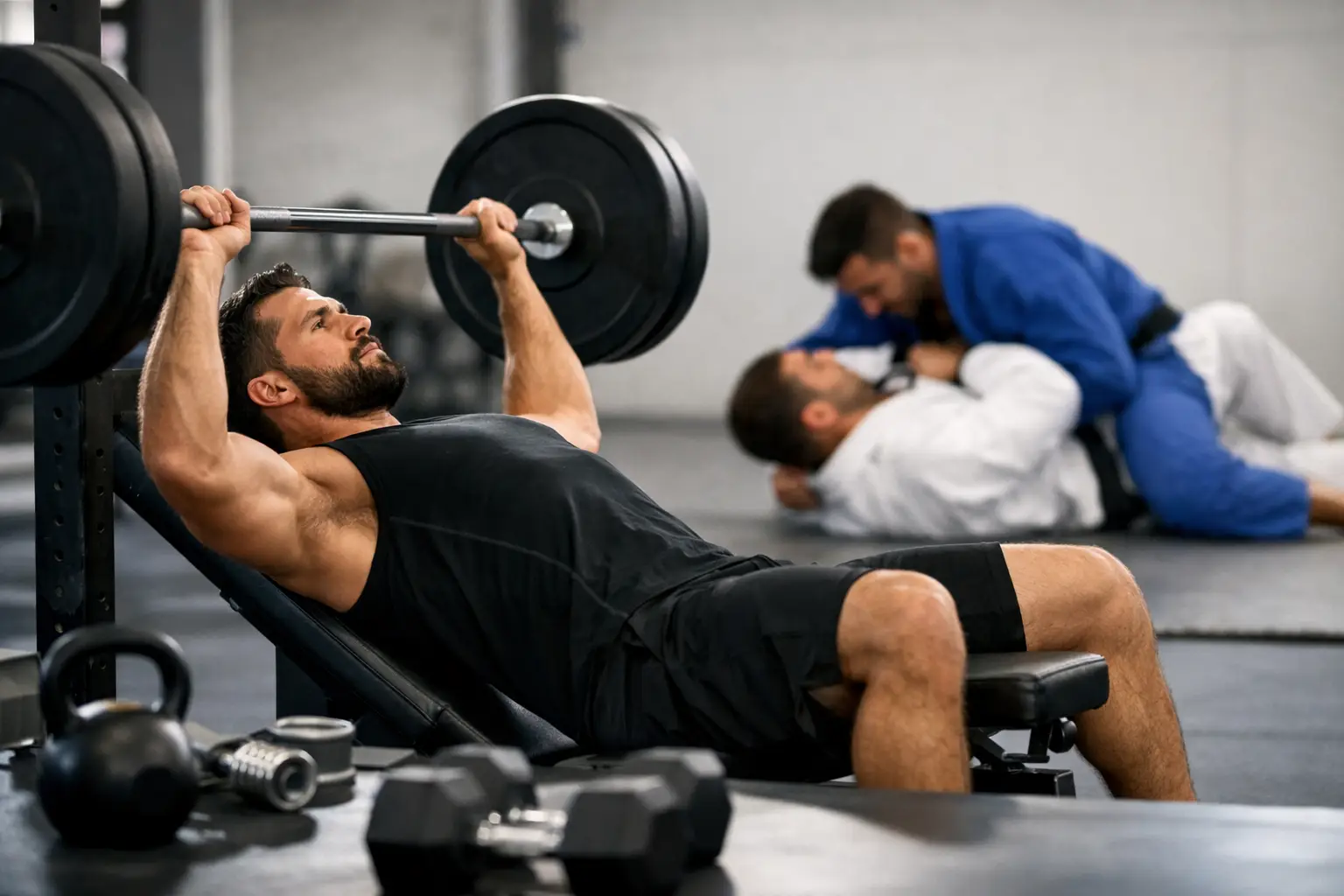
A hard Tuesday class can change what your Wednesday lift should look like. If you spent six rounds fighting for underhooks, defending takedowns, and getting stacked in guard, another high-fatigue session is not automatically productive. Strength training around BJJ classes works when it supports the work you do on the mat instead of competing with it.
The goal is not to cram more training into an already full week. It is to build explosive power, stronger grips, resilient joints, and the movement capacity to keep performing late in rounds. That requires a plan that accounts for class intensity, rolling volume, competition goals, sleep, and the condition of your body on a given day.
Treat BJJ as the Priority Stressor
Brazilian Jiu-Jitsu is not a light cardio activity that happens after the gym. Hard sparring creates substantial physical stress: high-force isometric contractions, repeated bursts of power, awkward joint positions, grip fatigue, and a large recovery cost. Your strength program has to recognize that.
Start by mapping the week honestly. Mark technical classes, hard rolling sessions, open mats, competition training, and any sessions where takedowns are emphasized. A drilling-focused class may leave room for a productive lower-body lift. A competition-style session with hard rounds may not.
This is where many grapplers get stuck. They follow a generic four- or five-day lifting split, then add BJJ wherever it fits. The result is often heavy legs before live takedown rounds, exhausted shoulders before a guard-passing session, or constant soreness that makes every class feel flat. The better approach is to place strength sessions around the highest-value mat sessions.
For most regular practitioners, two well-programmed strength sessions per week will produce better long-term results than four sessions performed with poor recovery. More can work, but only when total mat volume, training age, nutrition, and recovery capacity support it.
Build Your Week Around Hard Rounds
The simplest scheduling rule is to protect performance in your hardest BJJ sessions. If your toughest rolling happens Monday and Wednesday evenings, do not schedule demanding full-body lifts immediately before both classes. Put your most challenging strength work on days when you have enough time to recover before your next hard round.
A recreational grappler training BJJ three nights per week might lift on Tuesday and Saturday. Tuesday can be a moderate full-body session after a lighter class day or before an evening technical class. Saturday can carry more volume if Sunday is a rest day. A competitor who trains five or six times weekly may need shorter sessions, lower lifting volume, and a more deliberate split between heavy work and power work.
Training on the same day as BJJ is often practical. When possible, separate sessions by at least six hours. Lift first if strength is the primary goal that day, or train BJJ first if you need to be sharp for live rounds. If you have only one time window, avoid turning both sessions into maximal efforts. A concise strength session before a technical class can work well. Heavy squats before intense wrestling rounds usually create more cost than benefit.
Use Heavy Days Carefully
Heavy strength work is valuable for grapplers because it develops force production and durable tissue capacity. Squats, hinges, presses, pulls, loaded carries, and unilateral leg work all have a place. But heavy does not mean grinding every set to failure.
Keep most primary sets technically sharp, leaving one to three repetitions in reserve. This gives you a meaningful strength stimulus without creating fatigue that follows you into the next several classes. A hard set of deadlifts may help your posterior chain and takedown mechanics. Multiple sloppy sets after fatigue has taken over are more likely to compromise your back, grip, and mat performance.
Put Power Work Where It Can Be Fast
Explosive power training only works when you can actually move explosively. Jumps, medicine ball throws, kettlebell swings, fast push-ups, and controlled Olympic-lift variations belong early in a session, when fatigue is low.
Use low repetitions and stop when speed drops. For BJJ, this is not conditioning disguised as power work. The purpose is to improve your ability to bridge, shoot, scramble, and create force quickly. Two or three crisp sets can be enough when they are placed well in the week.
Match Volume to Your Current BJJ Block
Your strength training should change as your BJJ demands change. A stable off-season training block gives you room to build strength and muscle with slightly more volume. During a competition camp, BJJ intensity rises and strength training needs to become more efficient.
In a general development phase, two to three strength sessions may include more total sets, controlled accessory work, and a clear progression model. This is the time to address weaker links such as single-leg strength, pulling capacity, trunk control, shoulder stability, and hip mobility.
As competition approaches, maintain strength with fewer hard sets while keeping some explosive work in the plan. You do not need to chase personal records two weeks before a tournament. You need to arrive with power available, joints feeling good, and enough mat endurance to execute your game late in the bracket.
The final week before competition is not the time to test your conditioning. Reduce lifting volume, keep movements familiar, and avoid soreness-producing novelty. Your training should make you feel prepared, not prove how much work you can tolerate.
Choose Exercises That Carry Over to the Mat
Sport-specific training does not mean trying to imitate every BJJ movement with bands and unstable equipment. It means developing qualities that show up in grappling: force, control, rotation, pulling strength, hip extension, grip endurance, and the ability to resist being moved out of position.
Prioritize a foundation of squat or split-squat patterns, hinges, horizontal and vertical pulling, pressing, loaded carries, and trunk training. Then choose variations that fit your body and available equipment. A front squat may be a strong choice for one athlete, while a safety-bar squat or heavy split squat is more comfortable for someone managing shoulder irritation. Pull-ups are excellent for many grapplers, but chest-supported rows may be the smarter option when elbow or grip pain is limiting volume.
Calisthenics can also be productive when equipment is limited. Push-ups, chin-ups, ring rows, split squats, Nordic curl progressions, crawling patterns, and controlled isometrics can build meaningful strength when they are progressed intentionally. The key is not the tool. It is selecting the right movement, dose, and progression for the adaptation you need.
Let Recovery Decide the Day's Dose
A plan should guide you, but it should not ignore obvious recovery signals. A stiff shoulder after a heavy posting session, a tender elbow from relentless grip fighting, or unusually low energy after poor sleep may call for an adjustment.
Do not confuse intelligent adjustment with skipping every difficult session. Look for patterns. If your bar speed is consistently slow, your resting soreness is rising, and your rolling quality is declining, reduce training stress before it becomes a forced layoff. You might lower load, remove a set, swap a painful movement, or make the day a movement and recovery session.
Four signals deserve attention: declining performance across multiple sessions, joint pain that changes how you move, fatigue that does not improve after a rest day, and persistent irritability or poor sleep. These are not badges of commitment. They are programming feedback.
Injury-aware training keeps you developing while respecting the problem in front of you. A sore knee does not always mean no lower-body training. It may mean using a pain-free range, choosing a hinge pattern, slowing the tempo, or emphasizing isometrics while the issue settles. The right modification preserves momentum without pretending the limitation does not exist.
Track What Actually Improves Your Grappling
Bodyweight and gym numbers are useful, but they are only part of the picture. Track the lifts that matter, then connect them to your mat performance. Are you finishing takedowns with less effort? Can you maintain posture in long guard-passing exchanges? Do your hips still have power in the final round? Are your shoulders and elbows holding up through a full training block?
Use simple, repeatable benchmarks. Record loads, repetitions, session difficulty, sleep, soreness, and class intensity. Over time, this shows whether your program is building capacity or simply accumulating fatigue. MatFlow organizes this process around BJJ-relevant programming, phase management, exercise alternatives, and progress tracking, so your off-mat work can adapt to the demands of your actual training week.
The best schedule is rarely the most aggressive one. It is the one you can execute consistently while still showing up to class ready to learn, roll hard, and improve. Build strength with enough intention that it carries into your next scramble, not enough fatigue that it takes you out of it.