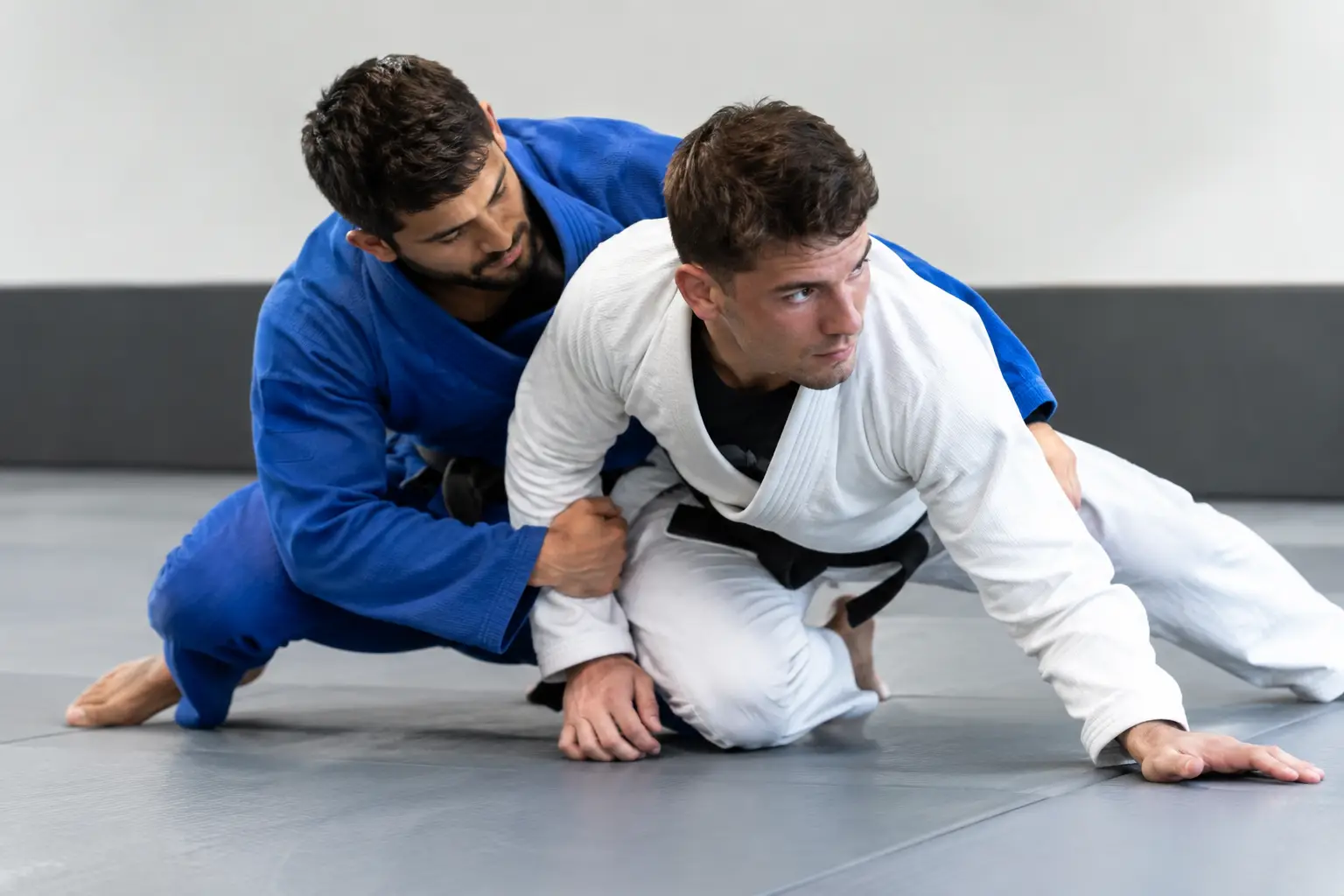
A scramble is not a single explosive movement. It is the moment you bridge, post, turn, pummel, recover your base, and attack again before your opponent settles the position. To improve scramble power for BJJ, you need more than a higher vertical jump or a harder deadlift. You need force you can express from awkward angles, after contact, while breathing hard, and without putting vulnerable joints at risk.
That is why random high-intensity workouts often miss the mark. They can make you tired without making you more effective during the three seconds that decide a reversal, a guard recovery, or a takedown finish. Better scramble power comes from a structured approach: build a strength base, develop fast force, train transitions, and condition the repeatability of those efforts.
What scramble power actually means in BJJ
Scramble power is your ability to create useful force quickly when position is unstable. On the mat, that may mean driving through a seated guard exchange, standing from a front headlock, rotating out of a leg entanglement, or using a hip heist to beat an underhook battle.
Pure strength matters because stronger athletes can create more force. But strength alone does not guarantee a fast, coordinated response. A grappler also needs rate of force development, trunk stiffness, hip mobility, shoulder stability, and enough aerobic capacity to repeat explosive efforts late in a round.
The trade-off matters. If you only train maximal strength, you may become powerful but slow to express it. If you only train explosive circuits, you may lack the force reserve to move a resisting opponent. Your training should give you both, with the amount of each adjusted to your current level, training schedule, and injury history.
Build strength that transfers to unstable positions
The foundation of scramble power is whole-body strength. Your legs and hips create the initial drive, but your trunk must transfer that force while your shoulders, elbows, and hands stay organized through posts and grips.
Prioritize squat, hinge, unilateral leg, push, pull, carry, and trunk patterns. The objective is not to collect exercises. It is to become difficult to fold, pull over, or pin during chaotic exchanges.
Train the hips and legs for base recovery
A strong squat pattern supports level changes, stand-ups, and the ability to reestablish base when someone is pulling you off line. Front squats, safety-bar squats, goblet squats, and split squats all have a place. The best option depends on your equipment, mobility, and how your back and knees tolerate loading.
Hinge work develops the posterior chain that drives bridges, lifts, sprawls, and stand-up finishes. Deadlifts, Romanian deadlifts, kettlebell deadlifts, and hip thrusts are useful choices. You do not need to chase maximal pulls every week. Consistent submaximal work with clean positions usually produces more usable strength and leaves more recovery for hard rolling.
Single-leg strength deserves special attention. Split squats, step-ups, and single-leg Romanian deadlifts build the hip control needed when one foot is posted, one knee is floating, and your opponent is trying to redirect you. That is most scrambles.
Build a trunk that resists collapse and creates rotation
BJJ does not reward a trunk that can only flex for high repetitions. You need to resist extension when bridging, resist rotation when someone drags you across your center line, and rotate forcefully when turning the corner on a takedown.
Use controlled anti-extension and anti-rotation work such as dead bugs, body saws, plank variations, and band or cable presses. Pair those with rotational patterns like medicine-ball scoop tosses or controlled cable rotations when available. Keep the intent athletic. The goal is to connect hips to hands, not just feel a burn in your abs.
Train durable shoulders and strong pulling patterns
Posting is a major part of scrambling, and careless training can irritate shoulders that already absorb a lot of mat volume. Rows, pull-ups, pulldowns, carries, and push-up variations develop useful upper-body strength without requiring aggressive overhead loading for every athlete.
If your shoulders are sensitive, choose neutral grips, elevated push-ups, chest-supported rows, and controlled ranges. Injury-aware adjustments are not a step backward. They are how you continue building capacity while protecting your ability to train consistently.
Convert strength into explosive power
Once you have a base of strength, train your body to produce force faster. Keep explosive work low in fatigue and high in intent. If jump height, speed, or technique drops sharply, end the set. Power training is not supposed to look like exhausted conditioning.
For most grapplers, two short power sessions per week are enough. Put them before heavy lifting or on separate days from your hardest sparring. Choose movements that you can perform confidently and land safely.
Useful options include broad jumps, vertical jumps, kettlebell swings, medicine-ball slams, rotational throws, plyometric push-ups, and low-volume hill sprints. You do not need all of them at once. Pick one lower-body movement, one upper-body or rotational movement, and perform three to five crisp sets of three to six repetitions.
A medicine-ball scoop toss has strong carryover to turning through an opponent in a scramble because it teaches hip drive and rotation. A broad jump reinforces horizontal force for shots and stand-ups. Kettlebell swings build rapid hip extension, but only when the hinge is already sound. If your lower back takes over, regress the movement rather than forcing speed.
Train the positions that create scramble opportunities
The weight room prepares the engine. Mat work teaches you where and when to use it. Add short positional rounds that repeatedly expose the transitions you struggle with.
Start from positions such as seated guard versus standing passer, turtle, front headlock, half guard underhook battles, body-lock exchanges, or a near-pass with frames in place. Set a simple goal: recover guard, stand up, secure top position, or clear the legs. Work in 10- to 30-second bursts, rest long enough to preserve quality, then switch partners.
This is where technical efficiency and physical power meet. A stronger hip escape helps, but only if your frame creates the space first. A faster stand-up matters, but only if your head position and hand fight prevent the opponent from collecting your legs. Do not use strength to compensate for a predictable movement pattern. Use strength to make correct mechanics harder to stop.
Build repeatability without turning every session into a war
A scramble rarely happens when you are fresh. You need conditioning that lets you regain composure, produce another burst, and make sound decisions after a hard exchange.
Start with aerobic work. Easy runs, bike sessions, rowing, or incline walking build the recovery system that restores you between rounds and between explosive efforts. This work should feel sustainable, not like another sparring session. Two 20- to 40-minute sessions each week can make a meaningful difference for many athletes.
Then add targeted intervals once or twice per week, depending on your BJJ volume. A practical option is 10 seconds of hard work followed by 50 seconds of easy movement for 8 to 12 rounds. Use a bike, sled, hill, or battle ropes if your joints tolerate them well. The hard segment should be aggressive, but you should recover enough to make each rep look similar.
More conditioning is not always better. If you train BJJ four or five days per week, hard intervals may reduce the quality of your lifting and live rounds. In that case, prioritize aerobic work and let your positional training provide the sport-specific intensity.
Organize your week around mat performance
The best plan fits the work you already do. A recreational athlete training BJJ three times weekly can often handle two strength sessions, two brief power exposures, and one easy conditioning session. A competitor in a high-volume camp may need shorter lifts, fewer hard intervals, and more attention to sleep, nutrition, and joint management.
Track the basics: loads used, jump quality, conditioning pace, soreness, and how your body feels in key scramble positions. If your power numbers rise but your legs are flat during rounds, the plan needs adjustment. Productive training is measurable, but it is also responsive.
MatFlow organizes strength, power, conditioning, and recovery-conscious adjustments around your BJJ schedule, so your off-mat work supports the rounds that matter instead of competing with them.
Your next scramble will not give you time to think about programming. It will ask whether your hips can fire, your trunk can hold position, and your engine can produce one more effort. Train those qualities with purpose, then give yourself enough recovery to bring them to the mat.