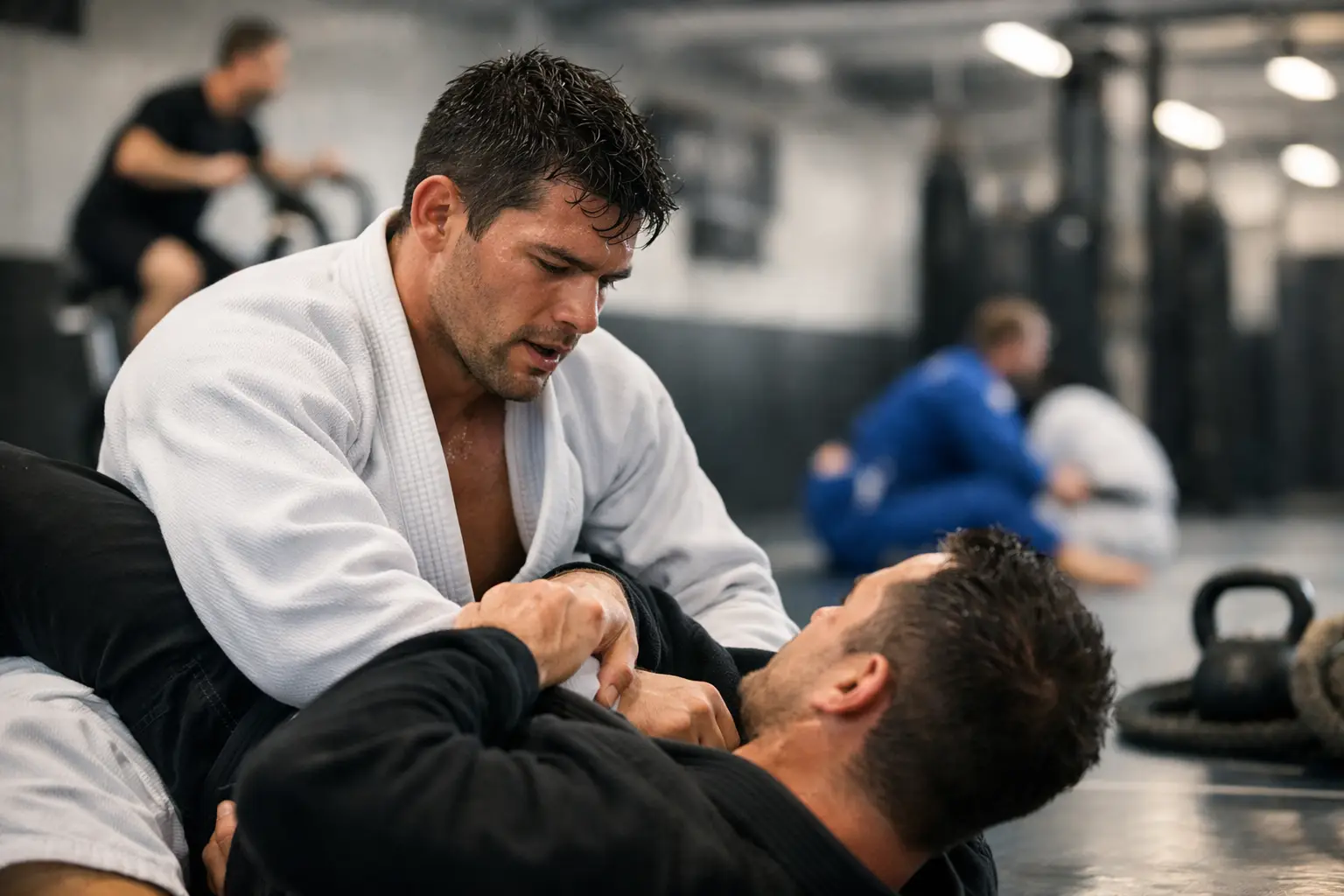
A hard five-minute round rarely exposes a lack of effort. It exposes a conditioning system that does not match the work. If you want to improve BJJ endurance, the goal is not simply to survive longer cardio sessions. It is to keep your posture, grips, decisions, and explosive escapes available when the pace rises and fatigue starts pulling your game apart.
That requires more than adding random running after class. Brazilian Jiu-Jitsu asks you to alternate between sustained isometric tension, explosive scrambles, awkward body positions, brief resets, and repeated high-output rounds. Your conditioning needs to prepare you for that exact pattern while leaving enough recovery to keep progressing on the mat.
What BJJ endurance actually means
Mat endurance is the ability to produce useful effort repeatedly without losing technical control. A grappler with strong endurance can hand-fight late in a round, maintain pressure without burning out their arms, stand up with intent after a scramble, and recognize when to settle rather than forcing a low-percentage attack.
That is different from being able to jog for an hour. Aerobic fitness still matters because it helps you recover between exchanges, rounds, and training sessions. But BJJ also demands anaerobic capacity for hard bursts and muscular endurance for prolonged gripping, framing, squeezing, posting, and carrying another person’s weight.
The common mistake is treating every conditioning session like a death circuit. That can make you tired, but fatigue is not automatically sport-specific adaptation. If your hard conditioning repeatedly compromises technical training, strength work, sleep, or joint health, it is not building a durable engine. It is creating more stress than your current schedule can absorb.
Build the aerobic base that supports hard rolling
Your aerobic system is the foundation underneath high-intensity work. It restores energy between scrambles, clears fatigue more efficiently, and helps you arrive at the next round with more than one gear left. For most adult grapplers, this is the most overlooked way to improve BJJ endurance.
Low-intensity conditioning should feel controlled, not heroic. A brisk incline walk, easy run, bike, rower, or steady swim can work well. Choose an option your joints tolerate and that does not leave your legs heavy for your highest-value BJJ sessions. The right pace allows short sentences, keeps breathing steady, and can be sustained without a battle of willpower.
Two sessions of 30 to 45 minutes per week is a productive starting point for many athletes. If you already train BJJ four or five days per week, begin at the lower end. The purpose is to add recovery capacity, not turn your week into a second sport.
Running is useful for some competitors because it is accessible and time-efficient. It is not mandatory. If shin pain, knee irritation, or accumulated mat volume makes running a poor fit, cycling or rowing may deliver the conditioning stimulus with less impact. Exercise selection should serve the plan, not your ego.
Train hard intervals with a grappler’s purpose
Hard intervals develop the ability to repeat intense efforts, but they need structure. Think of them as targeted preparation for the moments when a round becomes a scramble, a takedown exchange, or a sustained passing battle.
Start with one high-intensity conditioning session each week, ideally separated from your hardest rolling day. Use a bike, rower, sled, hill, or carefully selected circuit that allows forceful effort without reckless technique. The mode matters less than whether you can hit quality output, recover briefly, and repeat it.
A practical session might use six to 10 rounds of 30 seconds hard and 60 to 90 seconds easy. The hard work should be demanding, but it should not turn into uncontrolled flailing by round three. Over several weeks, add a round, slightly increase the work interval, or reduce rest. Change one variable at a time so the progression is measurable.
For athletes preparing for competition, intervals can become more BJJ-specific as the event gets closer. Longer work blocks with short recoveries can reflect tournament demands. Outside a camp, shorter, cleaner intervals often provide a better return with less recovery cost. You do not need to simulate a tournament every Tuesday in February.
Use positional rounds to expose the right fatigue
Specific sparring is one of the best conditioning tools because it develops endurance alongside decision-making. Start from a position that consistently challenges you: bottom side control, late-stage guard retention, front headlock defense, standing hand-fighting, or a passing sequence.
Set a clear work-to-rest structure. For example, perform several short rounds from the same position, rotating partners only when the format allows. This teaches you to spend energy with intent. You learn when to frame, when to move, when to breathe, and when a calm positional choice is better than a frantic explosion.
Use hard positional work strategically. If every class already includes six hard rounds, adding more maximal rounds is usually not the missing piece. Your better adjustment may be building aerobic work, improving strength, or managing your pacing during normal rolling.
Strength work protects your gas tank
Many athletes think they need more conditioning when they actually need more strength. If every takedown, bridge, technical stand-up, pull, and frame consumes a large percentage of your available strength, you will fatigue early regardless of how much cardio you do.
A stronger grappler can perform the same task at a lower relative effort. That does not mean chasing bodybuilding fatigue or testing max lifts every week. It means building usable force through patterns that transfer to grappling: squatting or split-squatting, hinging, pushing, pulling, carrying, rotating, and controlling your body through space.
Strength training also supports resilient shoulders, hips, knees, neck, and trunk. Those tissues matter for endurance because pain and instability change how you move. When your shoulder is irritated, your frames weaken. When your grip is overworked, you compensate with more arm tension. Small limitations can make an ordinary round feel like a conditioning problem.
Keep strength sessions focused. Two well-programmed sessions per week can move the needle for a grappler who is already training regularly. Prioritize progressive loads, clean repetitions, and enough recovery to maintain quality BJJ practice. MatFlow organizes strength and conditioning around these trade-offs, including exercise alternatives and adjustments when an injury or equipment limitation changes the plan.
Stop wasting energy during rounds
Your conditioning ceiling matters, but your energy management determines how quickly you reach it. White-knuckle gripping, holding your breath, trying to win every exchange, and exploding from poor positions are expensive habits.
Start by paying attention to your breathing. Exhale during effort instead of bracing through entire exchanges. Between movements, take slow breaths through the nose when possible. You will not breathe perfectly in a hard scramble, but a deliberate reset after the action can prevent one tough sequence from becoming a full-round spiral.
Next, assess your grips. A grip should have a job. If it is not breaking posture, preventing a pass, setting up an attack, or controlling a transition, release and reconnect with purpose. This is especially relevant for newer grapplers, who often turn every collar or sleeve grip into a maximum-effort hold.
Finally, give yourself permission to use position to recover. Strong frames, alignment, and connection can create moments to breathe without conceding the round. The best competitors are not relaxed because the pace is easy. They are relaxed because their technical choices reduce unnecessary effort.
Organize the week so endurance can improve
Endurance improves when training stress is repeated consistently, not when one brutal week is followed by ten days of soreness. Look at the full week: hard rolling, drilling, strength work, conditioning, work stress, family responsibilities, sleep, and old injuries all draw from the same recovery budget.
A sustainable week for a recreational grappler might include two to four BJJ sessions, two strength sessions, two easy aerobic sessions, and one interval session. That does not mean every athlete needs all of those pieces immediately. Someone training five intense nights per week may benefit more from one easy aerobic session and better sleep than another hard workout.
Place the most demanding sessions where they will not sabotage each other. Heavy lower-body strength and hard intervals on consecutive days can work for some athletes, but not if both leave you flat for key sparring. If competition performance is the priority, protect the sessions that develop technical skill and live grappling first. Your off-mat work should make those sessions better.
Track a few simple signals: rounds completed at your intended pace, how quickly your breathing settles, recurring soreness, sleep quality, and whether your technique stays available late in class. Progress is not only a higher heart rate score or a longer run. It is being able to make sound decisions in the fourth round when your partner is still driving forward.
Build your engine with patience, then test it under pressure. The grappler who can recover, recompose, and execute late in the session is not just better conditioned. They are harder to break on the mat.