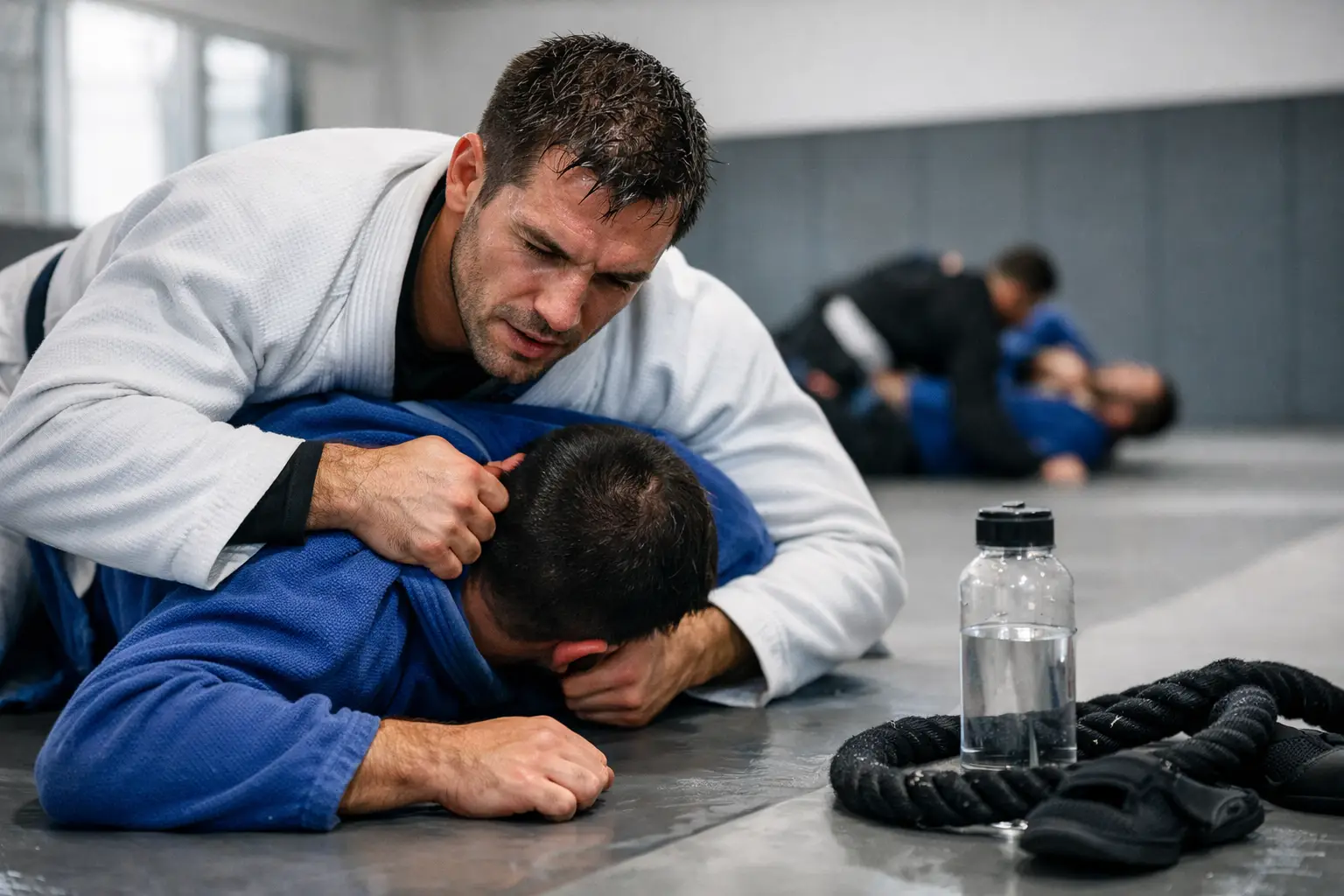
Your endurance problem may not be your cardio. If you can run for 30 minutes but fade after two hard rounds, the issue is usually the repeated force, gripping, bracing, scrambling, and decision-making that Brazilian Jiu-Jitsu demands. Learning how to improve BJJ endurance means preparing for those exact demands rather than just adding more random conditioning.
Mat endurance is the ability to produce useful effort, recover while you move, and keep making technical choices when your breathing gets heavy. It is not about being exhausted less often. It is about staying effective when the round becomes uncomfortable.
How to Improve BJJ Endurance: Train the Right Energy Systems
BJJ rounds are intermittent. A slow hand-fight can turn into a 15-second scramble, then settle into pressure passing, then spike again during an escape or submission attempt. Your conditioning needs to support all of it.
Your aerobic system is the foundation. It helps you recover between exchanges, clear fatigue between rounds, and maintain output during longer training sessions. Aerobic work does not need to leave you wrecked. Zone 2 running, cycling, rowing, or incline walking at a conversational pace builds capacity with relatively low joint stress. Two sessions of 30 to 45 minutes per week is enough for many grapplers, especially when class volume is already high.
Higher-intensity work has a different job. It prepares you to repeat hard efforts without falling apart technically. Short intervals, hill sprints, sled pushes, assault bike efforts, and hard carries can build this quality, but they need to be dosed carefully. If every conditioning session is an all-out test, your sparring quality and recovery will suffer.
A useful rule is simple: build the base first, then add intensity that matches your current phase. A recreational athlete training BJJ three times per week may improve dramatically with two low-intensity sessions and one short interval session. A competitor in a focused camp may need more sport-specific intensity, but even then, hard work should have a purpose.
Make Your Rolling More Intentional
Rolling is specific conditioning, but only when you control the purpose of the round. Going hard every class can build toughness for a few weeks. It can also create a cycle of sore joints, poor sleep, flat lifting sessions, and stalled progress.
Use different round types across the week. Technical rounds let you practice efficient movement and breathing without treating every position as a fight. Positional rounds create repeatable, high-demand scenarios such as escaping mount, retaining guard, finishing takedowns, or holding side control. Competition-style rounds test pacing, urgency, and the ability to recover under pressure.
This approach also exposes where you actually fatigue. If your forearms fail every time you play collar-sleeve guard, more running will not solve the problem. You may need better grip selection, more relaxed hand fighting, targeted grip endurance, and stronger pulling mechanics. If your legs burn during passing, look at your squat strength, hip mobility, stance efficiency, and the amount of unnecessary tension you carry.
Good BJJ endurance includes skill economy. The athlete who breathes, frames, and repositions intelligently often has more available energy than the athlete who tries to muscle every exchange.
Build Strength That Carries Into Long Rounds
Strength work improves endurance because a stronger athlete performs each movement at a lower percentage of maximum effort. If standing up in a scramble, holding posture in someone’s guard, or finishing a takedown takes less of your total capacity, you can repeat it longer.
Prioritize full-body patterns that transfer to grappling: squats or split squats, hinges, presses, rows, pull-ups, loaded carries, and trunk training that resists rotation and extension. You do not need a bodybuilding-style marathon in the gym. Two to three focused strength sessions per week can build the force reserve that makes hard rounds feel more manageable.
Calisthenics can work well when equipment is limited. Push-ups, chin-ups, single-leg squats, tempo split squats, crawling patterns, hangs, and controlled core work can build valuable capacity. The key is progression. Add load, range of motion, repetitions, pauses, or total quality volume over time instead of repeating the same workout until it stops producing results.
Grip work deserves attention, but do not make it the entire program. BJJ already provides a high volume of gripping. Add carries, towel hangs, gi pull-ups, or timed isometric holds only when your hands and elbows can tolerate the extra stress. For athletes dealing with elbow irritation or finger pain, neutral-grip pulling and open-hand variations may be a smarter choice than more maximal hangs.
Condition Without Sabotaging Your Mat Training
The fastest way to stall endurance gains is to pile hard sessions on top of hard sessions. A brutal circuit the day before tough sparring does not make you better conditioned. It often just means you practice BJJ while fatigued in a way that reduces learning and increases injury risk.
Organize your week around your hardest mat sessions. If Tuesday and Thursday are live-round-heavy classes, place your demanding strength or interval work farther away when possible. Easy aerobic work can fit closer to BJJ because it creates less recovery cost. A lighter mobility and tissue-care session may be the right choice after a hard night of rolling.
Pay attention to the signals that your plan is too aggressive: declining performance across several sessions, persistent joint soreness, worse sleep, unusually high resting fatigue, irritability, or a loss of motivation to train. Endurance improves through accumulated quality work, not by proving you can survive another workout.
For most athletes, the weekly priorities should be clear:
- BJJ skill training remains the main driver of performance.
- Strength training builds force, durability, and injury resilience.
- Low-intensity conditioning builds recovery capacity.
- High-intensity conditioning supports repeated hard exchanges.
- Recovery protects your ability to train consistently.
The exact balance depends on your training age, competition schedule, work demands, and injury history. Someone preparing for a tournament may temporarily reduce gym volume to make room for more specific rounds. Someone returning from a shoulder issue may prioritize strength and controlled aerobic work before adding aggressive intervals.
Use Breathing and Pacing as Trainable Skills
Many grapplers treat breathing as something that happens after they are tired. It is a performance skill you can practice during every round.
Start by noticing when you hold your breath. It often happens during guard retention, takedown entries, finishing pressure, or late-round escapes. Exhale during effort when you can, then use calmer nasal breathing in lower-threat positions to regain control. You will not always breathe perfectly in a scramble, but better awareness helps you stop turning every exchange into a panic sprint.
Pacing is not passive. It is knowing when to apply force and when to use position. If you are underneath side control, a controlled frame and incremental hip escape may preserve more energy than a full-power bench press escape that fails. If you are passing, settle your weight and make your opponent carry you before forcing the next movement.
Film study and honest reflection help here. Ask yourself after hard rounds: Where did I spend energy without improving position? Where did I lose posture? Which grips stayed on too long? Those answers often point to a technical solution, not another conditioning session.
Track the Work That Produces Better Mat Endurance
Progress should be visible. Track your BJJ rounds, perceived effort, conditioning sessions, strength numbers, sleep, and recurring pain points. You do not need to obsess over every metric, but you do need enough information to see whether your workload is moving you forward.
A simple marker is how quickly you recover between rounds. Another is whether your technique remains available late in class. You can also track repeatability: Can you produce similar output on the first, fourth, and sixth hard round without your movement becoming sloppy?
MatFlow helps organize that process with BJJ-specific strength and conditioning phases, customizable sessions, exercise alternatives, and progress tracking built around your actual training schedule. The goal is not to add more work. It is to give every session a job.
The grappler with the best endurance is rarely the one doing the most punishment. It is usually the one who develops an aerobic base, builds usable strength, trains hard efforts with intent, and recovers well enough to show up sharp again tomorrow.