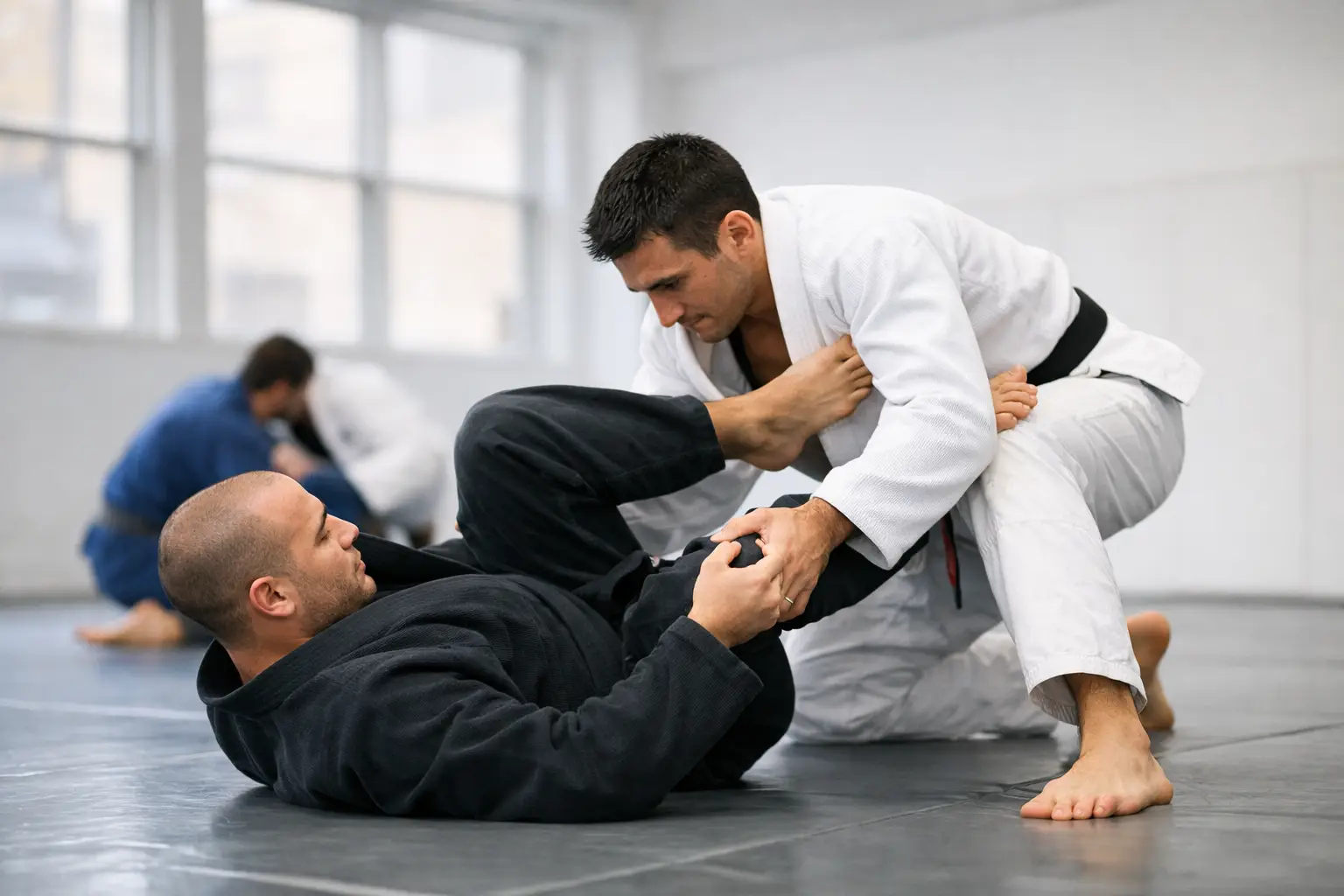
A guard that works when your partner is cooperative is not the standard. Guard retention matters when they are standing, cutting an angle, stapling a leg, peeling your frames, and forcing you to recover position while tired. The right guard retention exercises build the physical qualities behind those reactions: active hip range, trunk control, strong frames, and the repeatable movement capacity to keep your feet between you and danger.
Technical guard work still comes first. You need timing, distance management, grips, and an understanding of the passing position in front of you. But better physical preparation gives those skills a larger margin for error. When your hips can rotate without restriction and your trunk stays connected to your limbs, your recovery movements become faster, cleaner, and less costly over a hard round.
What Guard Retention Actually Demands
Guard retention is not just flexibility. A flexible athlete who cannot create tension, frame effectively, or move from one hip to the other under pressure will still get passed. It is a coordinated defensive task that asks you to maintain alignment while your opponent tries to separate your upper and lower body.
At a physical level, successful retention relies on hip flexion and rotation, adductor strength, hamstring control, trunk stiffness, shoulder stability, and the ability to post safely through the hands. It also requires repeated bursts of effort. You may invert, recover a knee shield, pummel your feet back inside, and immediately defend another pass attempt.
That is why a useful plan combines controlled mobility work with strength, positional movement, and conditioning. The goal is not to perform impressive gym movements. The goal is to make your next hip escape, frame recovery, or leg pummel more available late in the round.
Guard Retention Exercises That Transfer to the Mat
Hip Lift and Hip Switch
The hip lift and hip switch teaches you to move your pelvis independently while keeping your ribs organized. Start seated with both feet planted. Lift your hips slightly, rotate to one side, and bring the opposite leg through into a seated hip-switch position. Return under control and alternate sides.
Keep the movement smooth rather than throwing yourself from side to side. Your hands can assist at first, but reduce that support as your control improves. This exercise carries over to the small angle changes that let you square your hips to a passer before they clear your knees.
For most grapplers, two to three sets of six to 10 controlled transitions per side work well in a warm-up or movement block.
Supine Leg Pummeling
Lie on your back with your arms reaching toward the ceiling, knees bent, and shins roughly parallel to the floor. Alternate extending one leg while drawing the other knee toward your chest, then cycle smoothly through the pattern. Think about keeping your low back from aggressively arching as your legs move.
This is a simple way to train the coordination behind inside position. In guard retention, your legs need to move independently while your trunk stays organized enough to transfer force into frames and grips. Slow repetitions are valuable here. If you cannot control the pattern at a slow tempo, speed will only hide the weak link.
Progress by extending the legs farther, adding a light ankle weight, or using a resistance band only if you can keep your pelvis stable.
Dead Bug With Band Pulldown
Anchor a band overhead and hold it with straight or slightly bent arms, pulling it toward your thighs. From a dead-bug position, lower one heel toward the floor while keeping tension through the band and your ribs stacked over your pelvis. Alternate sides.
The band creates an active lat connection similar to using your upper body to reinforce frames. The lower-body movement challenges your ability to keep that connection while your legs reach, retract, and recover. It is especially useful for athletes whose legs move well but whose torso opens up under passing pressure.
Use two to four sets of five to eight reps per side. Stop the set if your back arches hard or the band pulls your shoulders out of position.
Copenhagen Plank
Your adductors do more than squeeze during closed guard. They help control hip position, pull the legs back to center, and stabilize your lower body when an opponent tries to split your knees. The Copenhagen plank trains this tissue in a way that also challenges trunk control.
Start with a short-lever version: support your top knee on a bench or stable surface, keep the lower leg bent, and hold a straight line from shoulder to knee. Build from 15- to 25-second holds before moving to a longer-lever position with the ankle supported.
Do not chase maximal discomfort. Adductors can be sensitive when BJJ volume is high, especially if you also play closed guard, wrestle, or train takedowns. Keep the dose conservative at first and increase only when soreness does not interfere with your next class.
Side Plank With Top-Leg Lift
A side plank with a controlled top-leg lift strengthens lateral trunk stability and active hip abduction. Those qualities matter when you are framing on one side, elevating a leg to block a hip, or trying to stop an opponent from circling around your guard.
Set up with your elbow beneath your shoulder, lift your hips, and raise the top leg without rotating your chest open. The range does not need to be large. A clean, controlled lift is more useful than a high leg that causes you to lose the plank.
Two or three sets of six to 12 lifts per side fit well after strength work or as part of a short accessory circuit.
Seated Technical Stand-Up
The technical stand-up is not only a self-defense movement. It trains a practical transition from seated guard or a scramble into a stable base while protecting space with the free hand and leg. Start seated with one foot planted, post the opposite hand behind you, and lift your hips as you bring the free leg back. Stand without crossing your feet or collapsing your posture.
Train both sides. Many grapplers have a preferred posting hand and stance, but passing exchanges do not always give you your preferred direction. Building competence on the less comfortable side makes your movement options more reliable.
Inversion Prep: Shoulder Walks and Wall-Assisted Hip Raises
Inversion is valuable for some guards and some body types, but it is not mandatory for every player. Before adding aggressive inversion drills, earn the ability to flex your hips deeply, tolerate weight through your shoulders, and control your neck position.
Shoulder walks are a lower-risk starting point. Lie on your back, lift your hips slightly, and use small steps through the shoulders to move your body forward and backward without loading the neck. Wall-assisted hip raises can add confidence: place your feet on a wall, roll your hips upward, and lower with control.
If you have a history of neck pain, cervical symptoms, shoulder instability, or recent injury, do not force this progression. Guard retention can be highly effective with frames, hip escapes, leg pummeling, and seated recovery mechanics. Your program should match your body and game, not an idealized movement checklist.
Put the Exercises Into a BJJ Training Week
The best guard retention work is usually short, consistent, and placed where it will not reduce the quality of your mat sessions. Use mobility and control drills in a 10-minute warm-up before class or lifting. Place higher-tension work, such as Copenhagen planks and banded dead bugs, after a strength session or on a separate conditioning day.
A simple two-day approach works for many regular BJJ athletes. On the first day, emphasize hip switches, supine leg pummeling, and dead bugs. On the second, use Copenhagen planks, side planks with leg lifts, technical stand-ups, and a conservative inversion progression if it suits your game.
Volume depends on your training load. During a competition phase with frequent hard rounds, keep the work crisp and low-fatigue. In an off-season or general strength phase, you can progress holds, add resistance, and develop more capacity. The exercises should support your rolling, not leave your hip flexors, adductors, or shoulders too fatigued to train well.
Measure the Result on the Mat
The gym metrics matter, but the real test is whether your guard becomes harder to clear. Track a few specific outcomes over several weeks: how often you recover inside position after a passing attempt, whether you can retain guard late in hard rounds, and which side breaks down first when opponents pressure-pass.
Also pay attention to recovery. If an exercise improves your movement but repeatedly aggravates your hips, groin, neck, or shoulders, the answer is not always to push harder. Change the range, leverage, tempo, or exercise selection. Intelligent progression protects consistency, and consistency produces durable improvement.
MatFlow organizes strength, movement, and conditioning around these BJJ demands, with adjustments that can account for training phases and injury limitations. Build the capacity your guard requires, then use it deliberately in positional rounds. The next time a passer wins an angle, your body should have more options ready before the pass is already complete.