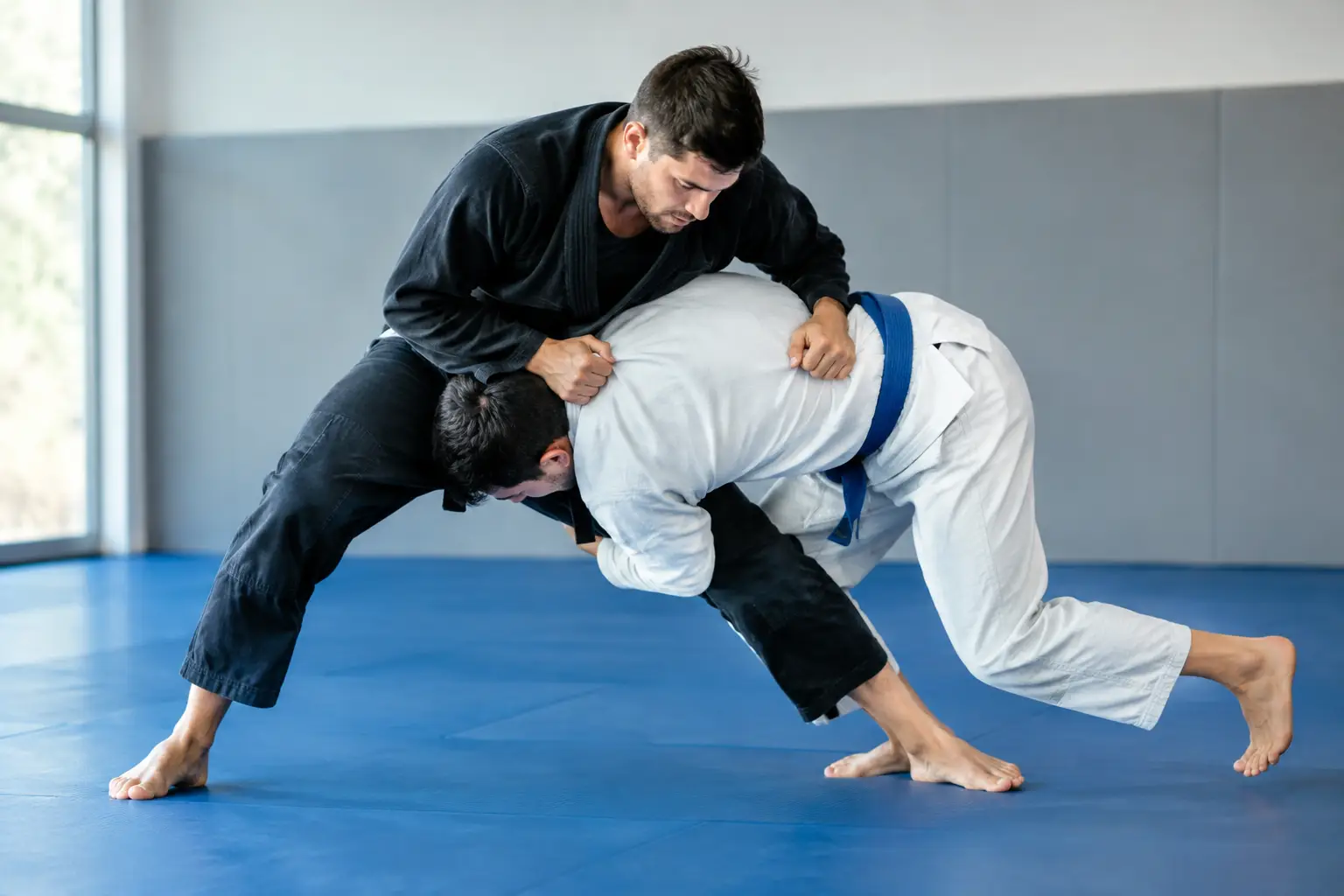
A clean double-leg rarely fails because an athlete does not know the finish. It fails when their level change is slow, their first step lacks intent, or their posture collapses under resistance. Explosive takedown training gives Brazilian Jiu-Jitsu athletes the physical qualities to make good technique show up when a partner is sprawling, framing, and fighting for position.
The goal is not to turn every grappler into a weightlifter or a track athlete. It is to build usable power: force that can be applied quickly from a stable base, transferred through the hips and trunk, and repeated without draining the energy needed for live rounds. For BJJ, that means training acceleration, braking, positional strength, and recovery as one system.
What Explosive Takedown Training Must Build
Takedowns are not one explosive movement. A successful entry usually includes a stance adjustment, level change, penetration step, contact, drive, angle change, and finish. Each phase asks for a slightly different quality.
The first step needs acceleration. The entry needs mobility and control through the ankles, knees, and hips. The finish demands leg drive, trunk stiffness, upper-body connection, and the ability to keep moving when the first attempt stalls. Then comes the often-overlooked requirement: braking. If you cannot decelerate into a strong position, your knees and lower back absorb the force while your opponent redirects you.
That is why jump training alone is not explosive takedown training. Box jumps can be useful, but they do not automatically improve a penetration step. Heavy squats can build strength, but strength without speed, timing, and movement capacity may not transfer well to the mat. The best plan develops a broad athletic base, then applies it to the patterns BJJ athletes use most.
Start With Strength You Can Control
Maximal strength is the foundation under explosive power. A stronger athlete has a larger force reserve, which means a submaximal shot or body-lock drive costs less effort. But the exercise selection must respect the demands already placed on your body by drilling, sparring, guard work, and scrambles.
Lower-body patterns such as squat variations, split squats, Romanian deadlifts, and hip thrusts can build the leg and hip strength needed for entries and finishes. Split squats deserve special attention because takedowns are rarely symmetrical. They challenge each leg independently while requiring pelvic control and balance through a long range of motion.
For the upper body, prioritize pulling strength, pressing stability, and trunk connection. Rows, pull-ups, push-up variations, loaded carries, and controlled anti-rotation work help you maintain posture when hands are fighting for collar ties, underhooks, and head position. The goal is not isolated muscle fatigue. It is creating a frame that stays connected when force moves from the floor through your opponent.
Train strength with intent, but do not treat every session like a test. Two to four quality strength sets per movement are often enough when hard BJJ sessions are already in the week. The right volume depends on your training schedule, competitive timeline, sleep, and injury history.
Build Single-Leg Capacity Before Demanding Speed
A takedown entry puts one leg in front, one leg behind, and both under pressure. If your knee caves inward during a split squat or you lose balance stepping down from a low box, adding high-volume plyometrics is not the answer.
Build control first. Use split squats, step-ups, single-leg Romanian deadlifts, and slow eccentric work to improve alignment and tissue tolerance. Strong feet, stable ankles, and capable hips make explosive work safer and more productive. This is especially relevant for athletes returning from knee pain, ankle sprains, or adductor strains.
Turn Strength Into Fast, Directed Force
Once basic strength and movement quality are in place, power work teaches you to express force quickly. Keep the dose low and the execution sharp. Power training is not conditioning. If jump height drops, landing quality deteriorates, or each rep feels slow, the useful work is finished.
A practical session may pair a strength movement with a complementary explosive drill. For example, a controlled split squat can be followed by a few broad jumps, or a trap-bar deadlift can be paired with low-volume vertical jumps. The pairing works because the strength exercise reinforces force production while the jump asks you to use that force quickly.
Horizontal power often has strong relevance for takedowns because entries and finishes move you forward. Broad jumps, skater bounds, and short hill sprints can develop acceleration and lateral redirection. Vertical jumps still matter, particularly for general lower-body explosiveness, but they should not be the only option in your plan.
Med-ball throws are another efficient tool. Rotational scoop tosses, chest passes, and overhead slams train force transfer through the hips and trunk without the joint loading of repeated barbell lifts. Choose a ball weight you can move fast. A heavy ball that turns every throw into a slow grind misses the point.
Add Takedown-Specific Movement Without Replacing Skill Practice
Strength and conditioning support technique. They do not replace drilling with a skilled partner. The bridge between gym power and mat performance is movement practice that reinforces positions without creating unnecessary fatigue.
Penetration-step repetitions, shadow shots, sprawls, stance-motion drills, and band-resisted entries can help athletes practice posture and direction. Keep the reps crisp. A tired, sloppy shot pattern is a poor pattern to repeat.
For example, after a warm-up, perform several short sets of penetration steps or shadow double-legs before lifting. Focus on a quiet level change, knee tracking, a strong back-leg drive, and eyes forward. Later in the session, use a small dose of broad jumps or med-ball throws. The movement practice gives your power work a technical reference point without trying to recreate hard wrestling practice in the weight room.
Partner drills remain the best place to learn timing, hand fighting, reactions, and finishing mechanics. Gym training earns its value when it helps you enter faster, hold posture longer, and repeat quality attempts deeper into a round.
Organize Training Around Your Mat Schedule
The biggest programming mistake is stacking demanding lower-body work immediately before your hardest sparring sessions. Heavy legs, intense sprinting, and high-volume jumps can leave you slow, sore, and less coordinated when it is time to train takedowns with resistance.
If you train BJJ three or four days per week, two focused strength-and-power sessions are usually enough. Place the more demanding session after a lighter technical day or with enough time before your toughest live rounds. A second session can use lower volume, upper-body power, unilateral strength, and trunk work.
During competition preparation, reduce lifting volume while maintaining intensity and speed. You want to preserve power, not chase new personal records when mat intensity is rising. During an off-season or a period with fewer hard rounds, you can spend more time building strength, tissue capacity, and movement options.
This is where personalized programming matters. An athlete with irritated knees may need sled drags, step-ups, and low-impact power options instead of repeated jump contacts. An athlete without gym access may use tempo split squats, explosive push-ups, hill sprints, and bodyweight movement progressions. The training objective stays the same even when the exercise changes.
Track the Signals That Matter
Better takedown conditioning is not measured only by barbell numbers. Notice whether your first step feels sharper late in class, whether you can finish a body lock without your posture folding, and whether your knees and hips recover predictably after training.
Track strength progress, jump quality, session difficulty, soreness, and BJJ workload. Those signals reveal whether your plan is building performance or simply adding fatigue. MatFlow organizes strength phases, exercise alternatives, injury-aware adjustments, and progress tracking around those decisions, so your off-mat work can support the sessions that matter most.
Explosive takedown training should leave you more prepared to attack, defend, scramble, and recover - not too fatigued to train your sport. Build force patiently, express it with precision, and let each phase of training serve the next hard round on the mat.