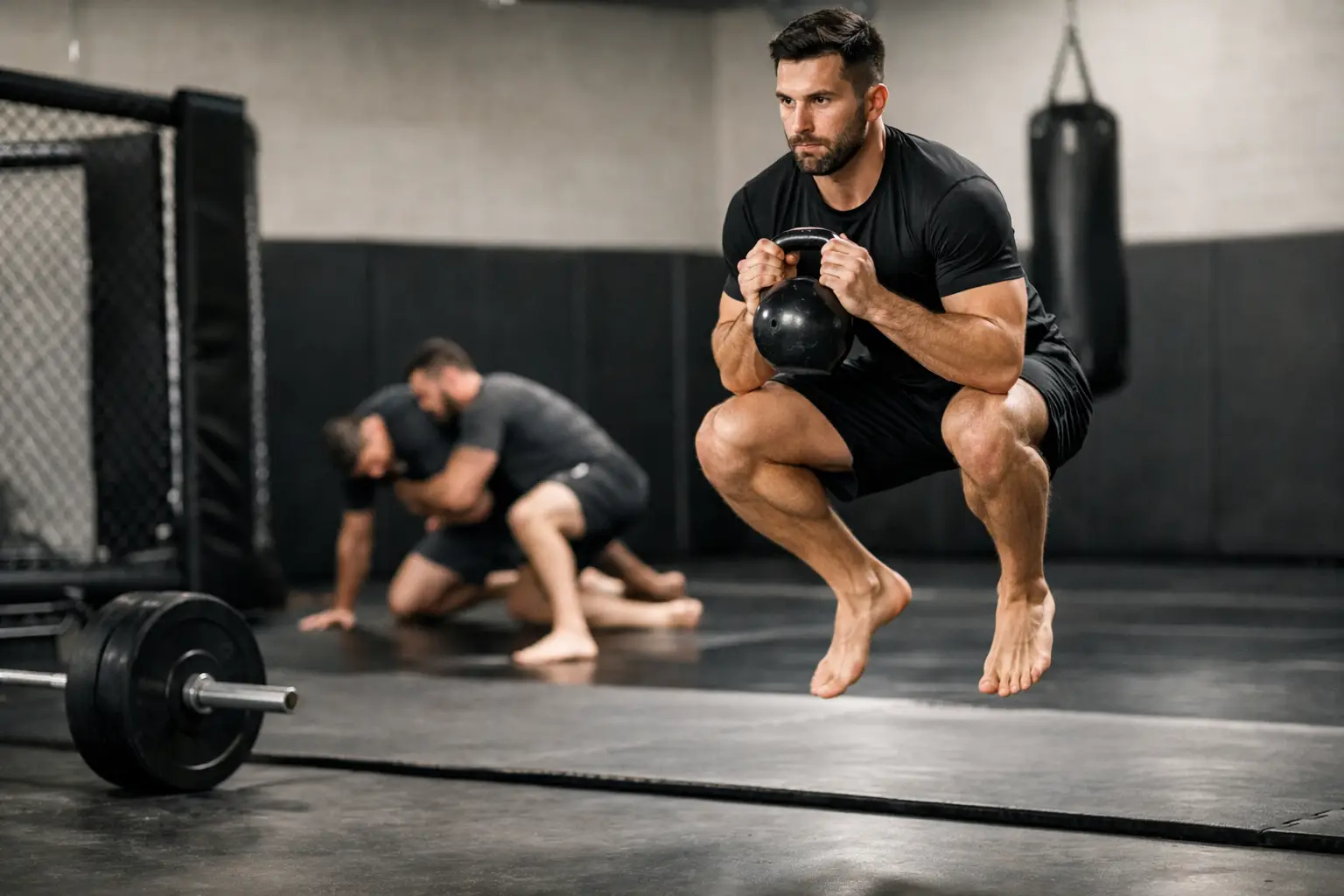
A clean double-leg finish, a hip escape that creates real space, and a scramble won in the first two seconds all demand more than strength. They demand the ability to produce force fast, from awkward positions, while staying connected to another athlete. The best explosive power exercises for grappling develop that quality without turning your strength work into another exhausting conditioning session.
For BJJ athletes, power training is not about chasing a higher box jump or performing flashy lifts for their own sake. It is about converting strength into actions that matter on the mat: penetrating on a takedown, elevating an opponent from butterfly guard, bridging under mount, standing up from bottom, and re-attacking during a scramble. The right exercise is the one you can perform with intent, progress safely, and recover from before your next hard round.
What Explosive Power Means in Grappling
Power is force expressed quickly. A strong athlete can move a heavy load. A powerful athlete can apply useful force before the position disappears.
That distinction matters in grappling. You rarely get unlimited time to finish a sweep or complete a body lock. You have a brief opening, an opponent who is resisting, and often a compromised base. Building maximal strength still matters because it raises your potential force ceiling. But if your training never asks you to move with speed, that strength may not show up as well when the pace spikes.
Power work should support your technical training, not compete with it. Keep reps low, execution sharp, and fatigue controlled. If jumps get slow, throws lose speed, or your landing mechanics deteriorate, the power portion of the session is over.
Explosive Power Exercises for Grappling
Broad jumps and vertical jumps
Jumps are a direct way to train rapid lower-body force production with minimal equipment. Broad jumps emphasize horizontal projection, which can carry over to level changes, penetration steps, and driving through a takedown. Vertical jumps train a more upright force vector and can improve general lower-body explosiveness.
Start from a stable athletic position, load the hips and knees quickly, then jump with full intent. Land quietly with the knees tracking over the feet. Three to five sets of two to four repetitions is usually enough. The goal is quality, not a leg-burning circuit.
If jumping bothers your knees, ankles, or back, use a low-impact alternative such as fast step-ups, explosive sled marches, or a controlled kettlebell swing. The best choice depends on your injury history, training age, and how much mat volume you are carrying that week.
Kettlebell swings
A well-executed kettlebell swing develops explosive hip extension, a key pattern for bridges, lifts, shots, and many sweeping mechanics. The movement is a hip hinge, not a squat with the bell hanging from the arms. Your hamstrings and glutes load the bell back, then snap the hips forward to send it up.
Use a weight you can move aggressively without losing your hinge. Sets of six to 12 repetitions work well when every rep stays crisp. Stop before your grip, lower back, or breathing becomes the limiting factor. Grapplers already accumulate plenty of grip fatigue through gi training, so swings should build hip power rather than become a forearm endurance test.
For athletes with limited equipment, a banded hip hinge or explosive glute bridge can train the same intent. Neither is identical to a swing, but both can fit a smart progression.
Medicine ball rotational throws
Rotational throws teach the trunk and hips to transfer force quickly. That transfer is useful when you are turning a corner on a shot, generating force from a seated guard, snapping an opponent during hand fighting, or changing direction in a scramble.
Use a wall and a medicine ball you can throw fast. Begin side-on, load into the trail hip, rotate through the floor, and release the ball with intent. Avoid turning this into an arm throw. The power should travel from the feet, through the hips and trunk, and out through the hands.
Perform two to four sets of three to five throws per side, resting enough to make every repetition fast. A lighter ball often produces better power training than a heavy one that forces you to grind. If you do not have a wall or ball, banded rotational punches can provide a useful alternative, although they require more control at the end range.
Plyometric push-ups
Plyometric push-ups train upper-body pushing power while requiring trunk stiffness and shoulder control. Those qualities can transfer to framing, posting, creating separation from bottom, and rapid hand fighting. They are also easier to scale than many explosive barbell pressing options.
Start with hands on a bench or box if floor plyometric push-ups are too demanding. Lower under control, press hard enough for the hands to leave the surface, and land softly with elbows slightly bent. Two to four sets of three to six reps is sufficient.
Shoulders that are irritated from heavy gripping, collar ties, or posting may not tolerate this exercise well. In that case, explosive incline push-ups with no airborne phase, or fast band presses, can maintain the intent with less impact. Pain is not a signal to push harder. It is a programming variable that needs an adjustment.
Explosive pull-ups and band-assisted options
Fast pulling strength matters when you are climbing into an opponent, pulling yourself through a guard pass, or breaking posture. Explosive pull-ups can be effective, but they are not appropriate for every athlete. They demand healthy elbows and shoulders, adequate baseline pulling strength, and disciplined control.
If you can perform strict pull-ups comfortably, use low-rep chest-to-bar pull-ups with maximal speed on the ascent and a controlled descent. If that is too advanced, band-assisted speed pull-ups, fast ring rows, or banded lat pulldowns offer a more accessible path.
Do not chase kipping repetitions for grappling power. The objective is forceful pulling with a stable shoulder, not accumulating momentum through the spine and hips.
Sprawls and stand-up drills
Some power work should look closer to the sport. Explosive sprawls, technical stand-ups, and hip-heist variations can build movement speed while reinforcing positional patterns you use in class. They are especially useful when competition is approaching and you want a lower-skill, sport-relevant power option that does not leave you sore.
Keep the volume short. For example, perform three to five repetitions per side with complete resets between reps. A fast, clean technical stand-up is more valuable than 30 rushed reps with poor posture and a tired shoulder.
How to Program Power Around BJJ
Place power exercises early in a strength session, after a general warm-up and before heavy lifts or conditioning. Your nervous system needs to be fresh enough to produce speed. Two power movements per session is usually plenty, such as broad jumps paired with medicine ball throws, or kettlebell swings paired with plyometric push-ups.
Most grapplers do well with one to three power exposures per week. The correct number depends on hard sparring rounds, lifting experience, sleep, bodyweight goals, and how close a competition is. A recreational athlete training BJJ three days per week may progress well with two short power blocks. A competitor in a hard camp may need to reduce volume and prioritize freshness.
Use longer rest periods than you might expect: roughly 60 to 120 seconds between low-rep sets. Power declines when fatigue rises, and slow repetitions train a different quality. Keep total volume modest, typically 15 to 30 high-quality contacts or throws per movement pattern in a session.
A simple session could begin with three sets of three broad jumps and three sets of four rotational medicine ball throws per side. Follow that with strength work such as split squats, rows, presses, and trunk training. This sequence creates a clear purpose: move fast first, get stronger second, and leave enough recovery capacity for the mat.
Build Power on a Strength Foundation
Explosive training cannot replace strength, mobility, or technical practice. A bigger jump does not fix poor level-change mechanics, and a harder kettlebell swing does not substitute for learning how to connect your hands on a body lock. Power is most useful when it is layered onto reliable movement skill and a solid strength base.
It also has to fit the athlete in front of the program. A heavier grappler may benefit from low-impact throws and sled work before accumulating many jump contacts. An athlete returning from a shoulder issue may prioritize lower-body power while rebuilding pressing tolerance. A smaller, experienced competitor may handle more plyometric volume but still need to protect recovery during demanding training weeks.
MatFlow organizes explosive work within a broader BJJ-focused system, so exercise selection, progressions, and alternatives can match your current phase, equipment, and limitations. Train with enough intent to become faster, but enough structure to stay available for the rounds where that speed matters.