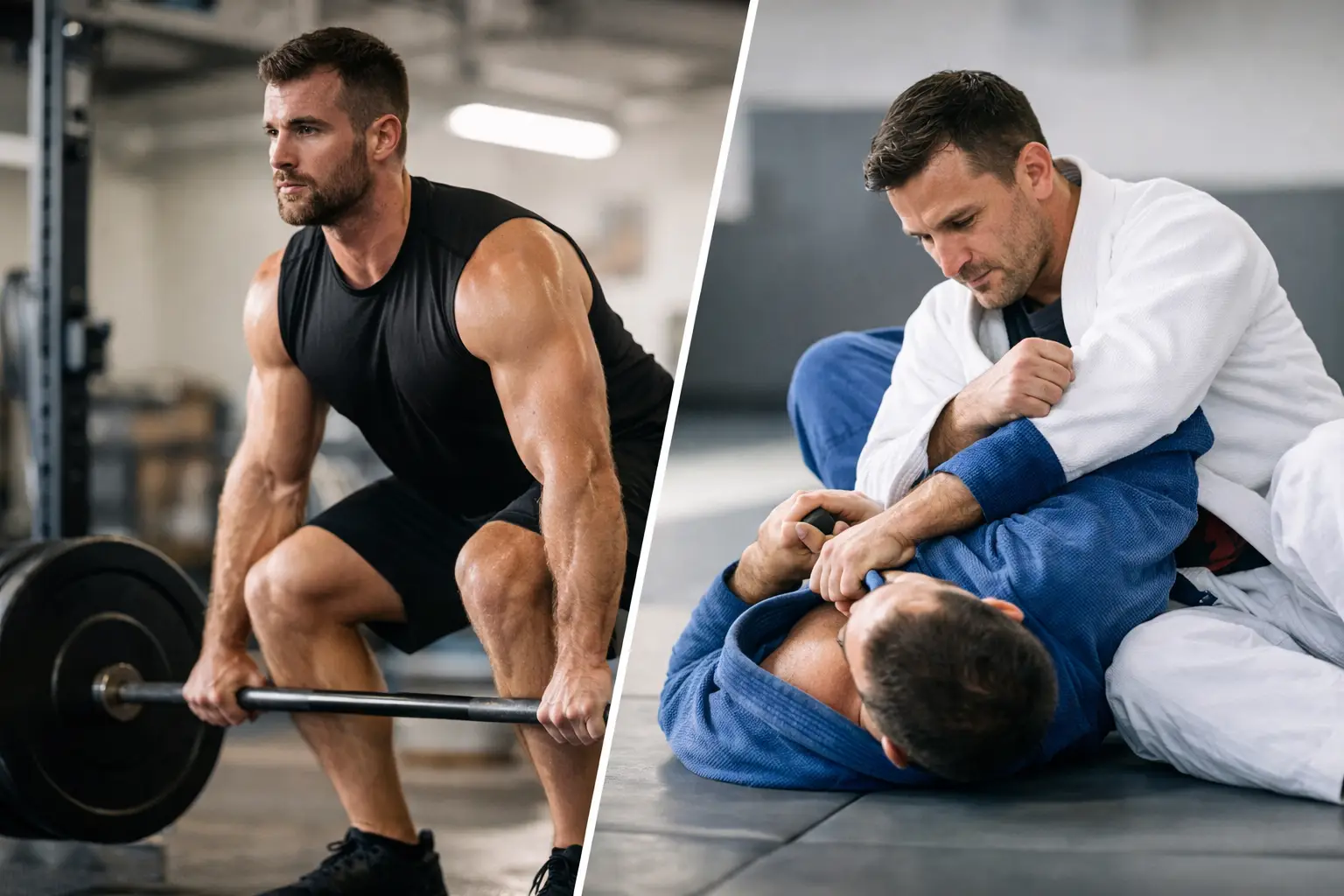
A heavier opponent settles into side control, and you know the escape. The problem is not knowledge. It is producing force from a compromised position, then repeating that effort for another five-minute round. That is where the question, does lifting improve BJJ, becomes practical rather than theoretical.
Yes, lifting can improve BJJ significantly - when it is programmed around the actual demands of grappling. The goal is not to become a gym specialist or chase numbers that leave you too sore to train. The goal is to build explosive power, stronger positions, resilient joints and tissues, and the mat endurance to apply your technique when fatigue rises.
Why Lifting Improves BJJ Performance
Brazilian Jiu-Jitsu rewards timing, leverage, and technical precision. Strength does not replace those qualities. It raises the ceiling of what you can do with them.
A stronger posterior chain can help you drive through a takedown finish, elevate an opponent during a sweep, and maintain pressure without burning out your arms. Better pulling strength supports posture fighting, grip exchanges, and rows from difficult angles. Stronger legs and hips improve your ability to stand, base, scramble, and generate force from guard.
The biggest benefit is often not a dramatic new move. It is reduced effort. When your body has more strength available than a position requires, you can use less of your total capacity to hold posture, frame, bridge, or resist being folded. That leaves more energy for decision-making and technical execution later in the round.
Lifting also builds capacity in tissues that take a beating in BJJ. Shoulders, elbows, knees, hips, neck, wrists, and the lower back are exposed to repeated loading in awkward positions. Intelligent strength work will not make grappling injury-proof, but it can improve your ability to tolerate training volume and recover from it.
Does Lifting Improve BJJ for Every Grappler?
It does, but the dose matters. A competitor training six hard sessions per week needs a different lifting plan than a recreational student attending class three times weekly. The right program depends on your current strength level, mat schedule, competition calendar, injury history, sleep, and recovery capacity.
If you are newer to lifting, two focused full-body sessions per week can produce meaningful gains. You do not need a six-day bodybuilding split. In fact, too much gym volume can interfere with your jiu-jitsu if it creates lingering soreness, stiffens up your movement, or leaves your grip and back exhausted before live rounds.
For experienced lifters, the challenge is usually not adding more work. It is choosing work that earns its place. A heavy squat, hinge, press, pull, loaded carry, and targeted single-leg exercise can deliver more BJJ value than a long session of isolated exercises performed to failure.
Strength training becomes less useful when it is disconnected from the rest of your week. If your hardest lower-body session lands the day before intense takedown rounds, you may feel slower, less coordinated, and more vulnerable to poor positions. Progress comes from organized stress, not from making every workout hard.
Build Strength That Shows Up on the Mat
A BJJ-focused lifting plan should train foundational movement patterns while respecting the rotational, isometric, and unpredictable demands of grappling. The best exercises are not necessarily exotic. They are selected and progressed with a clear purpose.
Prioritize force through the hips and legs
Takedowns, guard retention, bridges, technical stand-ups, and scrambles all rely on the lower body. Squat variations build leg strength and positional control. Deadlift and hinge variations train hip extension and posterior-chain strength. Split squats, step-ups, and single-leg Romanian deadlifts help address side-to-side differences while challenging balance and hip stability.
The goal is not to mimic a sweep with a barbell. It is to develop the raw force and control that make athletic movement easier to express on the mat.
Train pulling strength without living in grip fatigue
Rows, pull-ups, pulldowns, and supported pulling variations build the upper-back strength that supports posture, frames, collar ties, and grip fighting. But BJJ already asks a lot of your hands and forearms. If your fingers, elbows, or forearms are constantly irritated, adding maximal grip work to every gym session is usually a poor trade.
Use grip-specific training strategically, particularly if it supports your game. More often, build pulling strength with handles, straps when appropriate, and exercise variations that let your elbows and hands recover for the mats.
Strengthen pressing, shoulders, and trunk control
Pressing strength helps with frames, posting, and creating space, but shoulder health matters more than chasing a bench press record. Push-ups, dumbbell presses, landmine presses, and controlled overhead work can build strength while allowing useful variation in range and loading.
Your trunk also needs more than high-rep sit-ups. Grappling demands bracing, resisting rotation, transferring force between the hips and shoulders, and maintaining position while someone tries to twist or fold you. Carries, anti-rotation presses, dead bugs, controlled hanging work, and loaded movement patterns develop this type of usable control.
Keep power work crisp
Explosive power matters in shots, stand-ups, throws, and scramble exchanges. Jumps, medicine ball throws, kettlebell swings, and fast but controlled lift variations can help develop it. The rule is simple: power training should look powerful. Once speed drops and fatigue takes over, you are no longer training the quality you intended.
Use low-rep sets, full rest, and clean execution. Save grinding fatigue for sparring, where it has a direct purpose.
How to Fit Lifting Around BJJ Training
For most committed recreational grapplers, two strength sessions weekly are the highest-return starting point. Place them where they support your mat schedule rather than compete with it. If you have hard sparring on Tuesday and Thursday, a heavier full-body session on Saturday and a lighter or moderate session on Monday may work well.
During a competition phase, reduce lifting volume while keeping some intensity. Maintaining strength requires less work than building it. A few challenging but controlled sets can preserve your physical base without adding unnecessary fatigue during a demanding camp.
During an off-season or a period with fewer hard rounds, you can spend more time building. This is where structured phases matter. A phase focused on movement quality and tissue tolerance prepares you for heavier work. A strength phase builds force. A power-focused phase teaches you to express that force faster. Each phase has a role, and none needs to last forever.
Track more than the weight on the bar. Notice whether your shots feel sharper, your posture lasts longer, your recovery between rounds improves, and recurring aches become less frequent. Training data matters because it helps you adjust before fatigue becomes a problem.
Common Mistakes That Stop Strength From Transferring
The first mistake is treating lifting as punishment. If every session ends with exhaustion, your gym training is likely stealing from your BJJ rather than supporting it. Leave some repetitions in reserve on most sets and earn progression over time.
The second is training only the muscles you can see. BJJ athletes need strong legs, hips, upper back, trunk, and shoulders - not just chest, arms, and abs. A balanced program is more useful for movement quality and injury prevention.
The third is ignoring pain signals. Persistent joint pain is not a toughness test. Adjust the range of motion, exercise variation, load, tempo, or total volume. A neutral-grip press may be more tolerable than a straight-bar variation. A goblet squat may be the better choice while rebuilding knee confidence. Personalization keeps training productive.
Finally, do not assume more is better. The best plan is the one you can execute consistently alongside BJJ for months, not the plan that looks impressive for two weeks.
Train for the Grappler You Are Becoming
MatFlow approaches strength and conditioning as part of your jiu-jitsu development, not as a separate fitness hobby. Structured phases, BJJ-relevant exercise selection, injury-aware alternatives, and progress tracking help turn training into a system that fits your real schedule.
Lifting improves BJJ when it gives you more force, more control, and more durability without taking away from the sessions that matter most. Build the body that lets your technique survive hard rounds, difficult positions, and years on the mat.