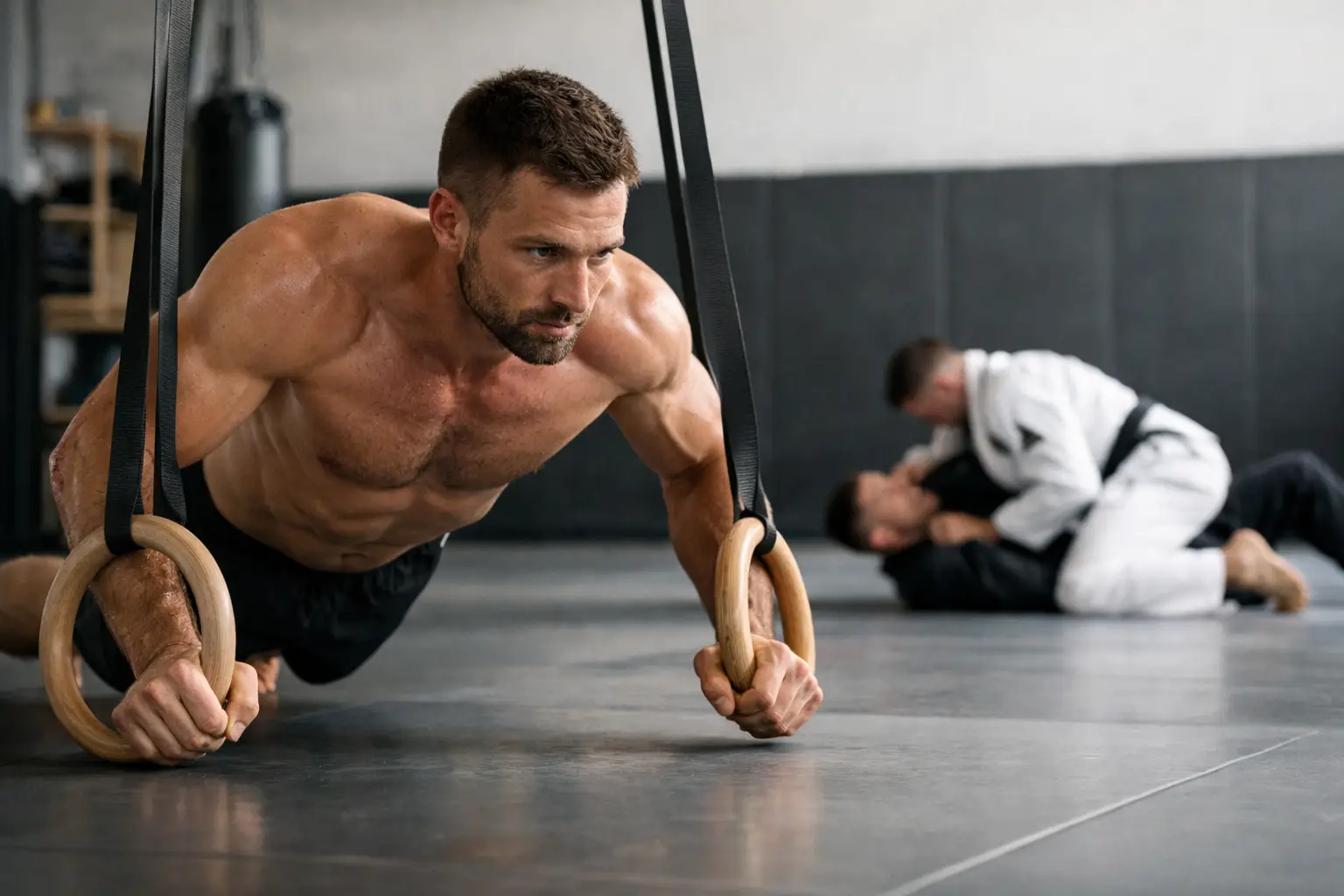
A hard round exposes weak links quickly. Your grip fades during hand fighting, your hips feel slow in a scramble, or your shoulders lose position when you are framing under pressure. A well-built calisthenics workout for BJJ targets those problems without adding unnecessary gym complexity. It develops usable strength, control, joint resilience, and conditioning that carries over to the mat.
Bodyweight training is not automatically BJJ-specific. High-rep push-ups and random circuits can build fatigue without improving the qualities that matter most in grappling. The difference is exercise selection, progression, training volume, and how your sessions fit around live rounds.
What BJJ Athletes Need From Calisthenics
Brazilian Jiu-Jitsu demands more than general fitness. You need the ability to pull an opponent close, keep your posture while someone breaks it, create force through your hips, move your bodyweight in awkward positions, and recover between repeated efforts. Calisthenics can support all of that when it is organized around movement patterns instead of novelty.
For most grapplers, the priority is relative strength. Being stronger at your current bodyweight improves climbing posture during a body lock, standing up from guard, controlling frames, and maintaining tension in scrambles. Pulling strength matters, but so do pushing strength, trunk control, single-leg stability, and shoulder mechanics.
The trade-off is clear: calisthenics has limits for maximal lower-body strength and loaded carries. Advanced athletes may eventually benefit from external resistance. But bodyweight work remains a powerful option for athletes training at home, traveling, managing a busy class schedule, or needing lower-impact alternatives during a training phase.
Build Your Calisthenics Workout for BJJ Around Patterns
Do not treat a session like a test of how many exercises you can complete. Choose movements that cover the essential physical demands of grappling, then progress them over time.
Pull for posture, grips, and control
Pull-ups, chin-ups, inverted rows, and towel-assisted hangs build the upper-back and elbow-flexor strength that supports collar ties, underhooks, grip exchanges, and pulling opponents into your attacks. Use a full range of motion and control the lowering phase. Fast, partial repetitions often create elbow irritation without delivering much strength benefit.
If you cannot complete clean pull-ups yet, start with feet-assisted rows, band-assisted pull-ups, and slow eccentrics. If standard pull-ups are easy, progress to chest-to-bar pull-ups, pause reps, uneven-grip variations, or weighted work when appropriate. The goal is not a circus trick. It is stronger, repeatable pulling under fatigue.
Push without sacrificing shoulder health
Push-ups, ring push-ups, dips, and pike push-ups develop pressing strength for frames, posting, and resisting pressure. They also demand scapular control when performed correctly. Keep your ribs from flaring, avoid shrugging into your ears, and use a range that your shoulders tolerate well.
Dips are effective for some athletes and irritating for others. If deep shoulder extension causes pinching or instability, do not force them because they are popular. Elevated push-ups, close-grip push-ups, or ring push-ups may give you the pressing stimulus you need with a better joint position.
Train the trunk to transfer force
BJJ is full of rotation, resisting rotation, flexion, extension, and bracing. Your trunk must transmit power from the ground through your hips and arms while keeping you organized under pressure. Hollow-body holds, dead bugs, side planks, hanging knee raises, and controlled bear crawls all have a place here.
Avoid turning every core exercise into a high-speed hip-flexor drill. For guard players especially, strong hip flexors are useful, but they are already heavily loaded by training. Balance them with exercises that teach bracing, pelvic control, and shoulder-to-hip connection.
Build hips and legs for shots and scrambles
Bodyweight squats alone are rarely enough for a serious grappler. Use split squats, reverse lunges, shrimp squats, step-ups, single-leg glute bridges, hamstring walkouts, and lateral lunges to create more meaningful lower-body demand. Single-leg training is especially valuable because takedowns, sprawls, guard passing, and stand-ups rarely happen from a perfectly symmetrical stance.
Move through controlled ranges before chasing speed. A knee that collapses inward during a fatigued jump or pistol squat is not athletic development. It is a signal to reduce the difficulty and earn better positions first.
A Practical Three-Day Bodyweight Plan
This framework works well for a grappler attending three to five BJJ classes each week. Schedule the harder strength sessions away from your toughest sparring days when possible. If you roll hard on Tuesday and Thursday, Monday and Friday are often better days for strength work.
Day 1: Pull and lower-body strength
Perform pull-ups or assisted pull-ups for 4 sets of 4 to 8 reps. Follow with Bulgarian split squats for 3 sets of 8 to 12 reps per side, inverted rows for 3 sets of 8 to 15 reps, and hamstring walkouts for 3 sets of 6 to 10 controlled reps. Finish with side planks for 2 to 3 sets per side.
Day 2: Push, trunk, and movement control
Perform push-up variations for 4 sets of 6 to 15 reps. Add pike push-ups for 3 sets of 5 to 10 reps, reverse lunges for 3 sets of 8 to 12 reps per side, hanging knee raises or dead bugs for 3 sets, then bear crawls for several short, controlled trips. Keep this day crisp rather than turning it into a conditioning punishment.
Day 3: Power and mat endurance
Start with low-volume explosive work while fresh: broad jumps, squat jumps, or explosive step-ups for 4 sets of 3 to 5 reps. Then complete a controlled circuit of rows, push-ups, split squats, crawling, and hollow holds for three to five rounds. Work for 30 to 45 seconds per movement, rest enough to maintain quality, and stop before your technique breaks down.
This third day should resemble the repeated-output nature of BJJ without trying to duplicate a hard open mat. If you have a competition approaching, conditioning can become more specific. In a high-volume week of rolling, reduce circuit rounds and protect your recovery.
Progress Without Outrunning Recovery
Progression is not limited to adding repetitions. You can make an exercise harder by improving range of motion, slowing the eccentric, adding a pause, reducing assistance, increasing sets, or choosing a more demanding variation. Change one variable at a time. Jumping from basic push-ups to maximal volume, deep dips, and plyometrics in the same month is a predictable way to irritate your shoulders.
Use a simple performance standard: finish most strength sets with one to three quality reps still available. This keeps sessions productive without leaving you flat for drilling and sparring. Save true all-out efforts for occasional testing, not weekly training.
Track your pull-up quality, single-leg volume, hold times, session difficulty, and how your body feels during key BJJ positions. If your elbows become tender after increased gi training, reduce hanging and aggressive grip variations before the problem becomes persistent. If your knees are sore after hard wrestling rounds, use more glute bridge and hamstring work while dialing back jumps and deep unilateral work.
A system like MatFlow helps organize these adjustments around your BJJ schedule, training phase, available equipment, and injury limitations. The value is not simply having more exercises. It is knowing when to progress, when to substitute, and when recovery will improve performance more than another hard session.
Make the Work Transfer to the Mat
Calisthenics should leave you better prepared to train Jiu-Jitsu, not too sore to practice it. Keep the main work focused, respect the quality of every repetition, and choose progressions your joints can tolerate for months. The best program is the one that makes your posture stronger, your movement sharper, and your gas tank more reliable when the next round gets difficult.