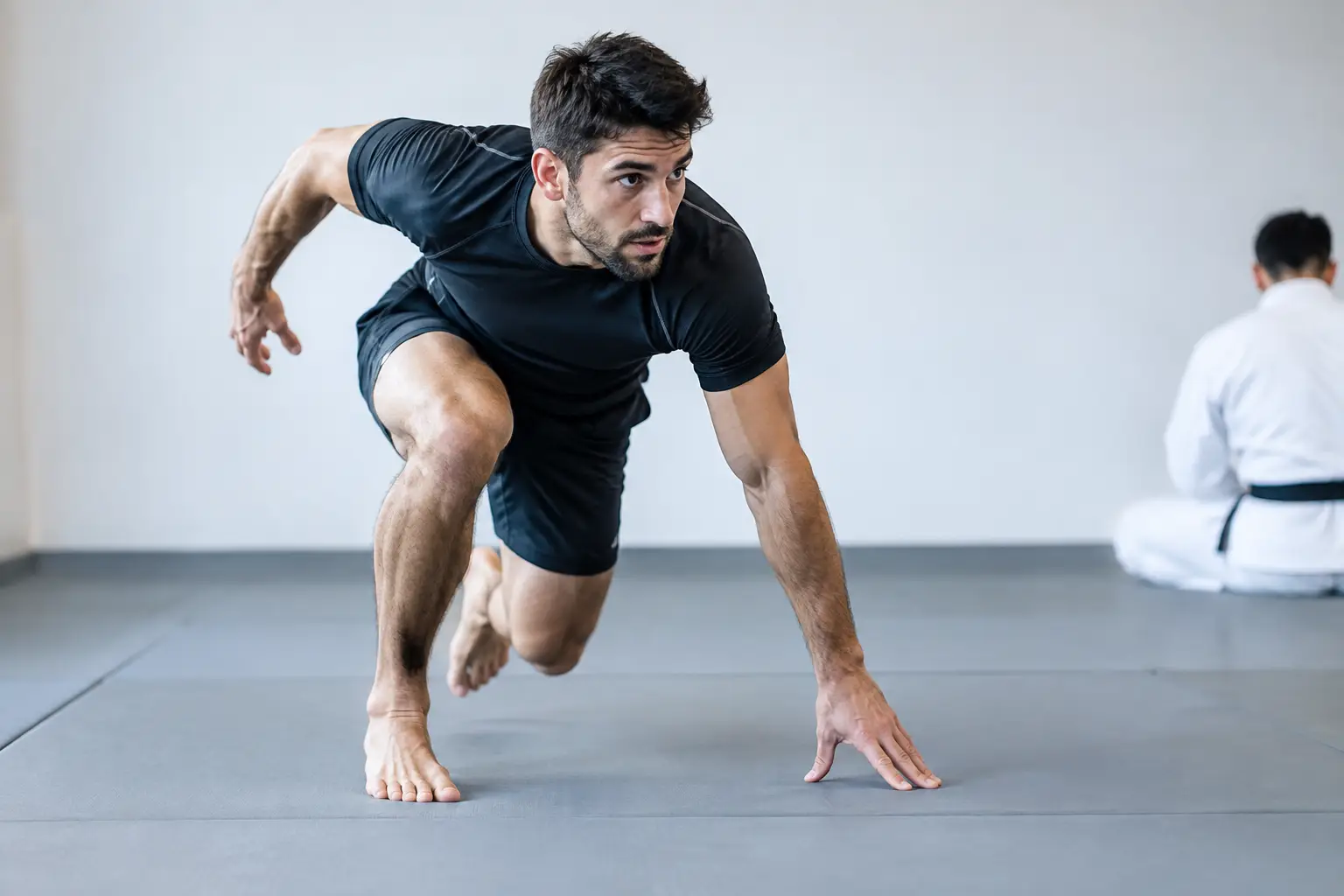
A slow hip escape is often not a technique problem. The same is true when your shot stalls halfway through, your bridge has no force under mount, or you lose the first scramble after a guard pass. To build explosive power for BJJ, you need more than random box jumps after class. You need a system that develops force, speed, and repeatability without draining the energy you need to train well on the mat.
Explosive power is the ability to create force quickly. In BJJ, it shows up when you penetrate on a takedown, elevate an opponent from butterfly guard, redirect during a scramble, bridge someone off balance, or stand up with intent. It is not about looking athletic for one rep. It is about producing useful force from awkward positions while tired, then recovering fast enough to do it again.
Why Power Training for BJJ Is Different
A vertical jump is useful, but BJJ power is rarely a clean, symmetrical movement. You drive through one leg while posting with an arm. You rotate under pressure. You pull, push, and change direction while managing another person's weight. That is why a power plan for grapplers starts with general athletic qualities but must eventually connect to the positions you actually use.
Strength is the foundation. If you cannot produce meaningful force, you have little force to express quickly. Mobility and tissue capacity matter too. Hips that cannot load, shoulders that cannot stabilize, and knees that hurt during deceleration will limit how hard you can train.
The trade-off is simple: more power work is not always better. High-impact jumps, hard throws, and maximal lifts create fatigue. If you also roll hard four or five nights per week, adding a large volume of explosive work can make your timing worse, not better. The goal is the minimum effective dose that makes you more dangerous and durable.
Build Explosive Power for BJJ From the Ground Up
First, earn your strength base
Before chasing speed, build dependable strength through fundamental movement patterns: squat, hinge, push, pull, carry, rotate, and brace. You do not need to become a powerlifter, but you should be able to move challenging loads with control and clean positions.
For most grapplers, lower-body strength has the highest return. Squat variations build leg drive for takedowns and stand-ups. Deadlift and hinge variations develop hip extension for bridges, lifts, and shots. Split squats and step-ups build unilateral strength that transfers well to kneeling, staggered, and asymmetrical positions.
Upper-body strength still matters, particularly pulling strength, pressing stability, and trunk stiffness. Rows, pull-ups, push-ups, carries, and controlled presses help you create frames, maintain posture, and transfer force through the torso. The best choice depends on your training age and injury history. A barbell is useful, but dumbbells, kettlebells, rings, bands, and calisthenics can build the same qualities when programmed progressively.
Use mostly moderate rep ranges for this phase. Sets of three to six reps on compound lifts can build strength without turning every workout into a recovery problem. Leave one or two solid reps in reserve more often than not. Grinding slow reps teaches you to survive a lift, not move explosively.
Then train speed with low-fatigue intent
Once you have a foundation, add movements that reward intent and speed. Jumps, medicine ball throws, kettlebell swings, plyometric push-ups, and short accelerations are practical options because they allow high output without complex technical demands.
A jump is only a power exercise if it is fast and crisp. The moment your landing gets heavy or your height drops noticeably, the quality of the set is gone. The same standard applies to throws and swings. Stop the set before fatigue turns speed work into conditioning.
For a grappler, start with simple options. Countermovement jumps teach rapid force production. Broad jumps build horizontal drive that carries over well to penetration steps and explosive stand-ups. Medicine ball chest passes and rotational throws train upper-body force without the shoulder stress of high-volume ballistic pressing. Kettlebell swings are effective for hip snap when you can hinge properly.
Do not force advanced plyometrics too early. Depth jumps, repeated bounding, and high box jumps can be useful, but they demand strong ankles, knees, hips, and landing mechanics. If you have recurring knee pain, recent ankle issues, or a heavy rolling schedule, use low-impact power options such as medicine ball throws, band-resisted movements, fast step-ups, or light sled pushes.
Connect power to grappling positions
Sport specificity is not copying a technique with a dumbbell. It is developing the physical qualities behind the technique, then practicing the technique on the mat. A heavy goblet squat will not replace drilling a double leg. It can give you more leg strength to finish it. A rotational throw will not teach a sweep, but it can improve your ability to create force through the hips and trunk.
Choose exercises that address your current bottleneck. If your shots lack drive, prioritize split-stance strength, broad jumps, and short acceleration work. If you struggle to elevate opponents from guard, use hinge strength, hip bridges, swings, and trunk bracing. If scrambles leave you flat-footed, add lateral bounds, fast sprawls with controlled volume, and get-up patterns.
This is where tracking matters. Instead of assuming a workout is helping, watch the indicators that matter: jump distance, load moved with speed, sprint or sled performance, how fresh you feel in hard rounds, and whether you can repeatedly explode late in class. MatFlow organizes this progression around BJJ training demands, so exercise choices and training phases can adjust as your classes, competition schedule, and limitations change.
A Weekly Structure That Fits Around the Mat
Most BJJ athletes do well with two dedicated strength-and-power sessions per week. This provides enough exposure to progress while preserving room for technical training and recovery. A third short session can work during lighter BJJ phases, but it is not mandatory.
Place your most demanding lower-body power session away from your hardest sparring day when possible. If Tuesday night is all-out rounds, do not schedule heavy squats and jumps Tuesday afternoon. Train power when you are reasonably fresh, because power is a nervous-system quality. Fatigue blunts it.
A simple session can begin with eight to 15 minutes of movement preparation, followed by a low-volume explosive exercise. For example, perform three to five sets of three broad jumps with full rest. Then move into two or three strength movements, such as a squat variation, a row, and a split squat. Finish with targeted trunk work, carries, or a small amount of conditioning if your mat schedule allows.
The second session can use a different power emphasis, such as medicine ball rotational throws or kettlebell swings, followed by a hinge movement, pressing variation, and pulling work. Keep the main work focused. A 45- to 60-minute session done consistently will outperform a two-hour gym session that leaves you useless for training.
During a competition build, reduce lifting volume but keep some intensity and speed. You are maintaining the qualities you built, not chasing new personal records. In a lower-stress off-season phase, you can spend more time building strength and gradually increase power volume.
Progress Without Turning Every Session Into a Test
Power training should feel sharp, not chaotic. Add reps, load, height, distance, or complexity gradually, but change only one variable at a time. If your broad jumps stay fast and your landings remain quiet, you might add a set or slightly increase distance. If you are using medicine ball throws, a modestly heavier ball is appropriate only if velocity stays high.
Use objective and subjective feedback together. Record loads, reps, jump distance, and workout completion. Also pay attention to elbow irritation from gripping, low-back tightness after hard rounds, sleep quality, and whether your joints feel ready to absorb impact. A good program has room to adjust when BJJ gets demanding.
If progress stalls, resist the urge to add more exercises. First look at recovery, class intensity, nutrition, and total lower-body volume. Many grapplers are not undertraining. They are doing too many hard things without a clear hierarchy.
The Power Standard That Matters
Your goal is not to jump higher than everyone in the academy. It is to create force at the exact moment a position opens, stay structurally sound when the exchange gets messy, and have enough reserve to do it again in the final round. Build strength patiently, train speed with quality, and let your weekly plan support your jiu-jitsu rather than compete with it. The best power program is the one you can recover from, measure, and carry onto the mat.