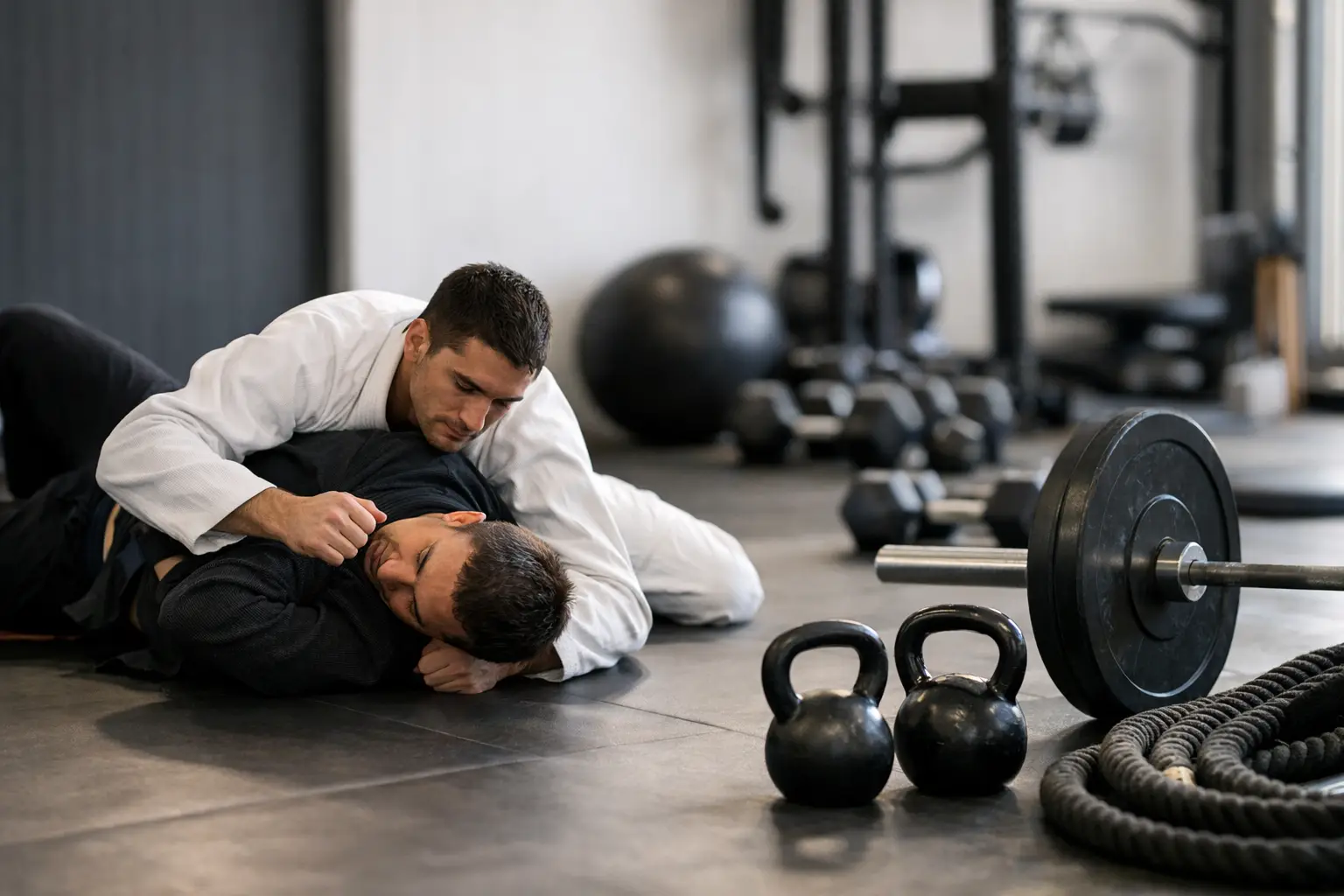
A hard round can expose every weak link in your preparation. Your grips fade during a long passing exchange. You cannot generate force for the second takedown attempt. Your shoulders or knees feel unreliable after a scramble. Brazilian jiu jitsu strength and conditioning exists to close those gaps with training that carries over to the mat.
For grapplers, the goal is not to collect gym numbers or leave every workout exhausted. The goal is to become harder to move, faster when a position opens, more durable under awkward load, and better able to recover for the next round. That requires a system built around BJJ training, not a generic workout split squeezed between classes.
What BJJ Strength and Conditioning Must Build
Brazilian Jiu-Jitsu asks for more than strength or cardio in isolation. A competitive round can demand a heavy isometric squeeze, a sudden bridge or hip escape, a full-body scramble, and then controlled pressure while fatigue climbs. Your training should prepare all of those qualities without stealing too much from your technical work.
Maximal and relative strength provide the base. Strong legs and hips improve takedown entries, posture, base, bridges, and the ability to create separation. Strong pulling and pressing muscles help you frame, grip, pull yourself into position, and resist being folded or flattened. Relative strength matters especially because better movement at your current bodyweight often improves guard retention, inversions, technical stand-ups, and scrambling.
Power turns that strength into usable speed. It shows up in a sharp penetration step, a fast hip heist, an explosive bridge, or the moment you capitalize on a brief opening. Power work does not need to be complicated. Jumps, medicine-ball throws, kettlebell swings, and controlled explosive calisthenics can work well when they fit your experience and injury history.
Conditioning has to match the uneven rhythm of grappling. BJJ is not a steady jog. It is repeated bursts of intense effort broken by brief periods of positional tension, hand fighting, and movement. Aerobic capacity still matters because it helps you recover between exchanges, rounds, and training days. But high-intensity intervals and sport-specific circuits are useful when they are placed carefully, not piled onto an already punishing week of sparring.
Finally, resilient tissue and movement capacity keep the whole system available. Neck, shoulder, hip, knee, ankle, wrist, and grip preparation may not feel glamorous, but they are often the difference between consistent training and another forced layoff.
Build Brazilian Jiu-Jitsu Strength and Conditioning Around Your Week
The best plan depends on how often and how hard you train BJJ. A recreational student attending two or three classes each week can usually build strength with two focused full-body sessions. A competitor training six or more times weekly may need shorter sessions, lower lifting volume, and stricter management of fatigue.
Start by protecting the highest-value work: technical practice, quality sparring, sleep, and recovery. Strength sessions should support those priorities. If heavy lower-body work leaves you slow and sore for your toughest wrestling class, move it farther from that session, reduce the volume, or choose a less fatiguing variation.
A practical two-day structure often works well. One session can emphasize lower-body strength, pulling strength, trunk control, and carries. The second can emphasize single-leg work, pressing, posterior-chain strength, grip development, and rotational or explosive work. Keep the sessions purposeful. Three to five well-chosen movements, followed by targeted conditioning or tissue work when appropriate, will outperform a long collection of exercises done without progression.
For example, a strength-focused day might pair a squat or deadlift variation with a pull-up or row, then include a unilateral leg movement, a carry, and neck or shoulder work. A power-focused day could use jumps or throws first, followed by moderate-load hinges, presses, rows, and core control. Exercise selection changes with equipment, skill level, and limitations, but the movement goals stay consistent.
Train the Qualities That Transfer to the Mat
A barbell is useful, but it is not mandatory. The right tool is the one that lets you train the intended quality safely and progressively. If a crowded gym, travel schedule, or home setup limits your options, calisthenics, dumbbells, kettlebells, bands, and loaded backpacks can still build meaningful capacity.
For lower-body strength, squats, split squats, step-ups, hinges, and hip thrusts develop force through patterns that support base, driving pressure, and level changes. Single-leg training deserves particular attention because BJJ rarely happens from a perfectly balanced stance. It can also help identify side-to-side differences that show up during passing, guard work, or takedown defense.
For the upper body, prioritize controlled pulling, pressing, and scapular stability. Pull-ups, rows, push-ups, landmine presses, and dumbbell presses all have a place. Avoid chasing high-volume pressing at the expense of upper-back strength and shoulder control. Grapplers already spend plenty of time with shoulders rounded forward and arms fighting for position.
Grip work should be deliberate rather than endless. Gi players benefit from crush, support, and pinch strength, but your fingers and elbows need recovery as much as development. Carries, hangs, towel variations, and controlled gripping drills can build capacity. Add them in measured doses, especially when your academy training already includes a lot of hard gi rounds.
Trunk training should teach force transfer and position control. Think anti-extension, anti-rotation, lateral stability, and strong hip-to-rib connection rather than hundreds of rushed sit-ups. Dead bugs, planks, side planks, carries, and controlled rotational patterns can improve how you brace while framing, bridging, lifting, and resisting pressure.
Condition Without Turning Every Session Into a Test
Conditioning should answer a simple question: what kind of fatigue is currently limiting your jiu-jitsu? If you gas after every scramble but recover well between rounds, short high-output intervals may help. If you feel depleted for the entire open mat and cannot recover between training days, a larger aerobic base and better overall recovery may be the missing pieces.
Low-intensity aerobic work is underrated for grapplers. Easy cycling, rowing, incline walking, or running at a conversational pace builds work capacity with relatively low joint stress. One or two sessions per week can support recovery and make hard training more repeatable.
Hard conditioning earns its place when it is specific, brief, and recoverable. Use intervals on a bike, rower, sled, or hill to train repeated output without adding unnecessary technical injury risk. Keep the hardest conditioning away from your hardest sparring when possible. If your rolling is already intense, adding several brutal circuits each week can reduce performance instead of improving it.
Progress in Phases, Not Random Workouts
BJJ athletes need structured training phases because the calendar changes. An off-season or lower-volume period is a good time to build strength, add muscle where useful, and develop movement capacity. As a competition approaches, maintain strength with less volume, sharpen power, and control fatigue so your technical sessions stay fast and productive.
Progression does not always mean adding weight. It can mean more reps with clean form, a harder exercise variation, better range of motion, shorter rest at the right time, or improved consistency across several weeks. Track the work. If your pull-ups, split squats, carry loads, conditioning intervals, and recovery markers are moving in the right direction, you have evidence that the plan is working.
This is where personalized programming matters. A 20-year-old competitor with a healthy lifting background should not receive the same progression as a 42-year-old hobbyist managing a sensitive knee and training after work. MatFlow organizes training around your BJJ schedule, goals, equipment, and limitations, with exercise alternatives and phase-based adjustments that keep preparation connected to mat performance.
Make Injury-Aware Decisions Early
Pain is not a badge of commitment. Persistent joint pain, declining performance, poor sleep, and a rising sense of dread before training are signals to adjust the dose. That may mean reducing sets, changing range of motion, using a friendlier variation, or replacing a high-impact conditioning session with lower-impact aerobic work.
Do not confuse training around an issue with ignoring it. A sore shoulder may tolerate rows, carries, and lower-body training while pressing is temporarily reduced. A cranky knee may respond better to controlled split squats, sled work, and cycling than repeated jumping. When pain is sharp, worsening, or persistent, get qualified medical guidance.
Your best off-mat program is the one you can execute consistently while still arriving at class ready to learn, spar, and improve. Build strength patiently, condition with a purpose, and let your training support the jiu-jitsu you want to play tomorrow as much as the round you want to win today.