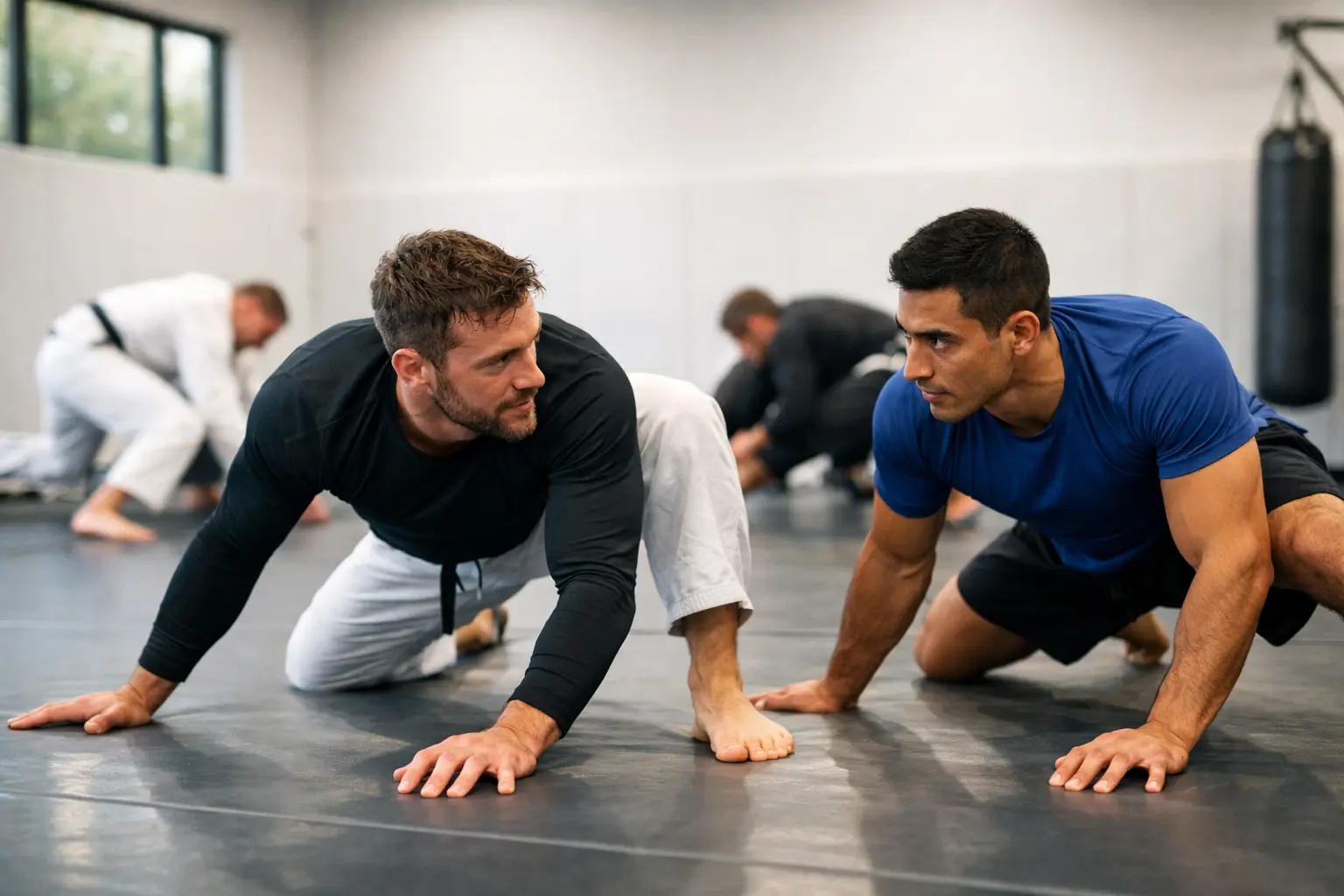
The first scramble of class should not be the moment your hips, shoulders, and lungs finally wake up. A productive BJJ warm up prepares you to post, invert, shoot, frame, bridge, and grip with intent before the pace rises. It is not extra conditioning. It is the transition between the demands of your day and the demands of live grappling.
For most practitioners, the goal is simple: arrive at the first round moving well, feeling stable, and ready to produce force without spending the energy you need to train. That requires more than jogging laps and static stretching. Your warm-up should raise temperature, restore usable ranges of motion, activate positions you will actually use, and rehearse the patterns that make Brazilian Jiu-Jitsu demanding.
What a BJJ Warm Up Is Meant to Do
A good warm-up does not need to be complicated, but it does need a purpose. You are preparing joints and tissues for unusual angles, repeated isometric tension, explosive transitions, and contact. Your shoulders must tolerate posting and framing. Your neck needs control under pressure. Your hips need to rotate, flex, and extend through guard retention, wrestling entries, and escapes. Your trunk must transfer force while resisting unwanted rotation.
The key is to create readiness without fatigue. If your warm-up leaves your forearms pumped, your legs burning, or your breathing ragged before technique starts, it has crossed into a workout. That can make sense before a conditioning session, but it is rarely the best move before hard rolling.
The right dose depends on the session. A technical class may only need eight to 10 minutes of preparation. Before competition rounds, open mat, or a takedown-heavy practice, 12 to 15 minutes can be worthwhile. Cold weather, a long commute, poor sleep, or a stiff training partner schedule may also justify a slightly longer ramp-up.
Build Your BJJ Warm Up in Four Stages
A reliable warm-up follows a progression: increase heat, open active movement options, reinforce control, then rehearse grappling patterns. This sequence is more useful than chasing a random list of drills because it gives every minute a job.
1. Raise Your Temperature Without Burning Energy
Start with two to four minutes of low-impact movement. Light jump rope, an easy bike, brisk walking, shadow wrestling, or controlled solo flow all work. The target is a light sweat and easier breathing, not a hard conditioning stimulus.
Keep the pace conversational. If you can only breathe through your mouth after two minutes, back off. You are creating a base for movement quality, not testing your engine.
2. Move Through the Ranges BJJ Demands
Next, use dynamic mobility that reflects the positions you will need on the mat. Spend one or two controlled sets on each area rather than holding long passive stretches.
For the hips, use deep squat prying, alternating Cossack squats, hip switches, and reverse lunges with rotation. These movements prepare adductors, glutes, and hip rotation for guard play, level changes, and base recovery.
For the upper body, include scapular push-ups, shoulder circles, band pull-aparts if available, and controlled thoracic rotations. A shoulder that can move and stabilize is better prepared to frame, pummel, and post than one that has only been stretched.
Do not neglect ankles and wrists. Ankle rocks can improve comfort in squatting and wrestling stances. Wrist circles, palm pulses, and gentle quadruped rocking help prepare the hands for gripping and posting. Keep these drills controlled, especially if you have a history of wrist, elbow, or shoulder irritation.
3. Add Stability and Position-Specific Control
Mobility only helps if you can control the range you gain. This stage should wake up the muscles that stabilize common BJJ positions without turning into a strength circuit.
A short combination might include glute bridges, dead bugs, side planks, and bear-position shoulder taps. Glute bridges reinforce hip extension for bridges, lifts, and takedown finishes. Dead bugs and side planks build trunk control for resisting extension and rotation under pressure. Bear-position work asks the shoulders and trunk to stabilize while weight shifts from side to side, much like posting during scrambles.
Use deliberate repetitions. Five to eight quality reps per side, or 15 to 25 seconds for a hold, is usually enough. The goal is to feel connected and stable, not to chase a burn.
4. Rehearse Mat Movement at Low Intensity
The final stage should look recognizably like grappling. Use solo movement to coordinate your hips, shoulders, trunk, and breathing before a partner adds resistance.
Hip escapes, bridges and shoulder walks, technical stand-ups, sit-throughs, sprawls, penetration steps, and controlled granby-style rolls can all fit here. Choose the movements that match the day. If class centers on wrestling, prioritize stance motion, level changes, penetration steps, and sprawls. If you are working guard retention or inversions, give more attention to hip escapes, shoulder rolls, and controlled inversion patterns.
Start smooth and build speed only if the movement stays clean. A rushed technical stand-up with a collapsing knee or a sloppy sprawl that jars your lower back does not prepare you well. Precision first, pace second.
A 10-Minute BJJ Warm Up Template
This template works before most general classes and can be adjusted to your current training phase:
- Spend two minutes on light jump rope, bike work, or shadow wrestling.
- Perform six hip switches per side, six alternating Cossack squats, and eight ankle rocks per side.
- Complete eight scapular push-ups, eight glute bridges, six dead bugs per side, and 15 seconds of side plank per side.
- Finish with two controlled rounds of hip escapes, bridges, technical stand-ups, sit-throughs, and either sprawls or penetration steps.
Move continuously, but do not rush. Most athletes finish this in about 10 minutes and feel noticeably more prepared without sacrificing mat endurance. If time is limited, keep the first, third, and fourth stages. Those are the minimum effective pieces for most healthy practitioners.
Adjust the Warm-Up to Your Body and Session
A generic warm-up is better than none, but personalized preparation is more effective. Your training history, current soreness, injury limitations, and class plan should change the exercise selection.
If your shoulders are sensitive, prioritize scapular control, thoracic rotation, and gradual posting exposure. You may replace fast sprawls with a slower step-back sprawl or use an elevated position for shoulder taps. If your knees are irritated, reduce high-rep shots and deep loaded flexion early in the session. Focus on hip activation, ankle movement, and controlled stance work before building speed.
A stiff lower back often needs more than aggressive stretching. Try breathing-led trunk control, hip mobility, glute bridges, and gradual rotational movement. The objective is to create options through the hips and thoracic spine so the lower back does not have to handle every transition.
On days when you lift before BJJ, your warm-up should also reflect what your strength session already covered. A hard lower-body workout may mean you need less volume of jumping or shot entries before class. A desk-bound day with no prior training may require more mobility and pattern rehearsal. Train smarter by treating readiness as a moving target, not a fixed checklist.
Common BJJ Warm-Up Mistakes
The most common mistake is confusing exhaustion with preparation. Long burpee sets, hard sprint intervals, and high-rep grip work may feel tough, but they can reduce the quality of your drilling and live rounds. Conditioning has a place in BJJ training, yet it should be programmed with intent rather than accidentally squeezed into every warm-up.
Another mistake is using only passive stretching. Long holds can feel relieving, especially after sitting all day, but they do not automatically prepare you to stabilize a posted arm, explode into a shot, or recover guard. Pair mobility with controlled strength and sport-specific movement.
Finally, avoid copying a warm-up that ignores your limitations. The athlete with a healthy history of inversions, the beginner learning technical stand-ups, and the competitor managing a cranky knee do not need identical preparation. This is where structured programming matters. MatFlow helps organize BJJ-relevant warm-ups, exercise alternatives, and training adjustments around your goals and the way your body is responding.
Make Readiness a Trainable Skill
Your warm-up is a small part of the session, but it affects everything that follows: how confidently you shoot, how safely you post, how quickly you scramble, and how much quality work you can accumulate over time. Repeating a focused sequence also gives you useful feedback. When a hip feels restricted, a shoulder lacks control, or your breathing is unusually elevated, you know to adjust before intensity exposes the problem.
Use your BJJ warm up as your first technical round of the day. Move with the same attention you want during sparring, then step onto the mat ready to train hard and perform better.