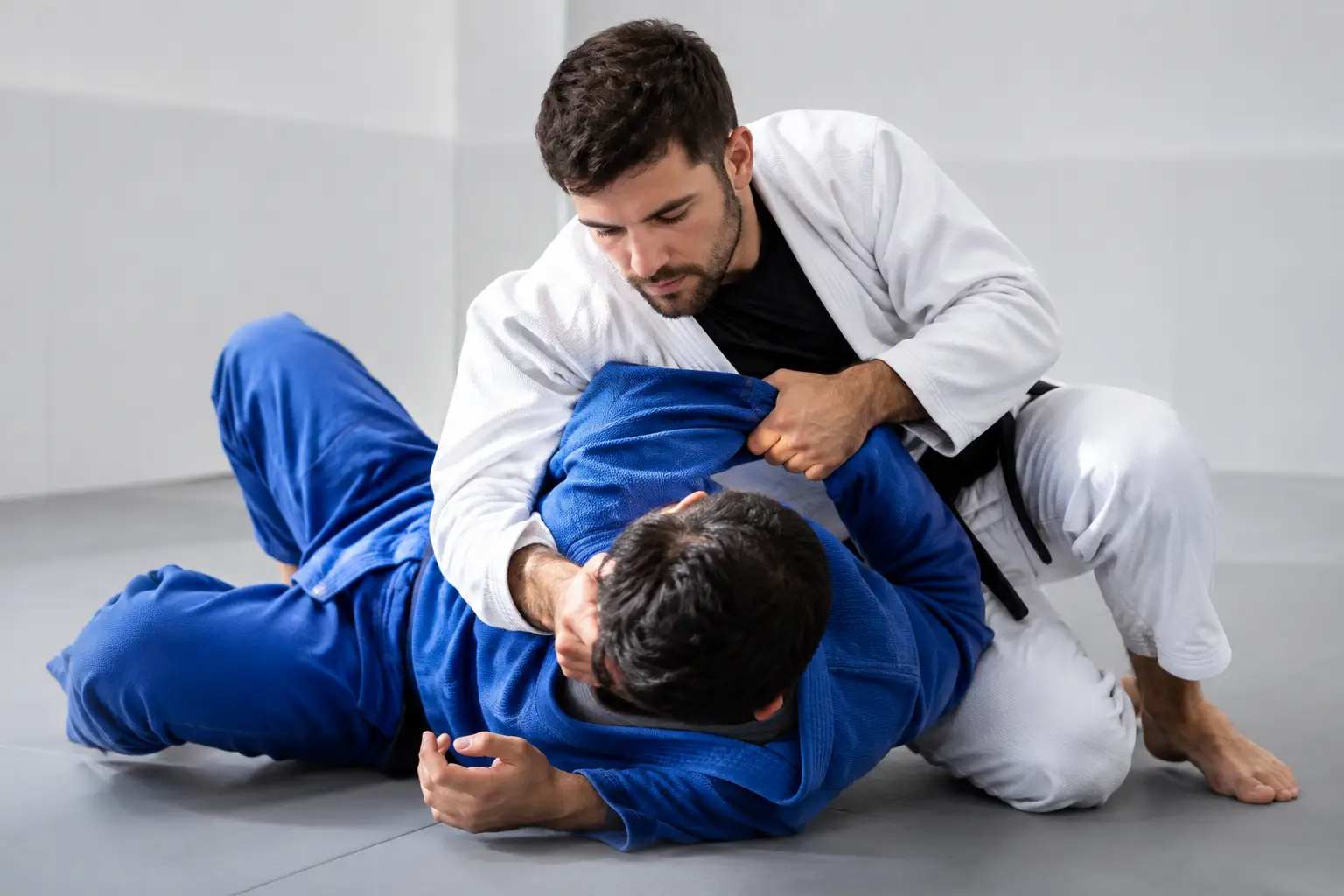
Your shoulder rarely gets a clean, predictable rep in Brazilian Jiu-Jitsu. It gets pulled across your body during arm drags, loaded while posting in a scramble, compressed under side control, and fatigued while fighting for inside position. A useful BJJ shoulder stability guide has to prepare you for those changing demands, not just make you better at a few gym exercises.
For grapplers, shoulder stability is the ability to keep the joint organized and strong while force changes direction. It supports harder frames, more confident posts, stronger pulling mechanics, and the capacity to keep training through a demanding week. It is not about making the shoulder rigid. You need controlled mobility, strength through useful ranges, and enough endurance to maintain position late in rounds.
Why BJJ challenges shoulder stability
The shoulder is built for movement. Its shallow socket gives you the reach needed to frame, pummel, underhook, grip fight, and attack submissions. That same freedom means the surrounding muscles must constantly create control.
In BJJ, the shoulder often works under fatigue and in awkward positions. A posted hand can take force from your bodyweight and a partner's movement. A deep underhook may require you to resist your arm being pulled behind you. Guard retention asks the shoulder girdle to stay active as you use your arms to manage distance. None of this looks exactly like a machine press or a casual band circuit.
The goal is not to eliminate all discomfort or make injury impossible. Contact sports carry risk. The goal is to increase your capacity so common positions are less likely to exceed what your tissues, strength, and coordination can handle.
Start with position, not random shoulder exercises
A stable shoulder starts at the rib cage and shoulder blade. If your ribs flare, your upper back collapses, or your shoulder blade loses contact and control, the ball of the shoulder joint has less support. This is why pressing, pulling, carrying, and crawling all matter when they are performed with intent.
Think of three qualities working together:
Scapular control
Your shoulder blade needs to upwardly rotate when you reach overhead, protract when you frame and punch, retract when you row, and remain controlled when a partner pulls on your arm. Many grapplers only train retraction with rows. Rows are useful, but a shoulder blade that cannot protract under load is often underprepared for posting and framing.
Push-up variations are one of the simplest ways to train this. Use a full, controlled range, then add a small reach at the top without rounding your entire upper back. That reach trains serratus anterior, a key muscle for keeping the shoulder blade connected to the rib cage.
Rotator cuff strength
The rotator cuff does not need flashy training. It needs consistent exposure to manageable resistance in multiple arm positions. External rotation work can help, but only if it progresses beyond an easy band drill done with the elbow glued to your side forever.
Train external rotation with the arm by your side first, then progress toward supported 90-degree arm positions if they are pain-free. Isometric holds are especially useful when the shoulder is irritable because they can build tolerance with less joint motion. Keep the resistance controlled. If you have to twist your torso or shrug your shoulder to finish the set, the load is too heavy.
Whole-body force transfer
A shoulder does not operate separately from the trunk, hips, and legs when you grapple. A strong frame uses the floor, your core, and body alignment. Carries, planks, split-stance presses, and controlled get-up variations teach the shoulder to maintain position while the rest of the body moves.
That transfer matters for takedown defense, posting out of transitions, and creating pressure from top position. Local shoulder work builds the pieces. Integrated strength teaches those pieces to work when the round gets chaotic.
The most useful shoulder stability exercises for grapplers
Your program does not need 12 shoulder drills. It needs a small group of movements that cover pressing, pulling, rotation, scapular control, and loaded stability. Select exercises that you can load, repeat, and progress without aggravating symptoms.
A practical BJJ shoulder stability guide can include these five categories:
- Push-up plus or elevated push-up plus: Builds pressing strength, serratus control, and a stronger reaching position for frames.
- Chest-supported row: Trains upper-back strength without using fatigue or lower-back momentum to finish the rep.
- Cable or band external rotation: Builds cuff strength in a controlled position. Progress range and resistance gradually.
- Half-kneeling single-arm press: Challenges shoulder control while the trunk resists unwanted rotation and rib flare.
- Suitcase carry: Loads one side of the body, demanding grip, trunk stiffness, and shoulder organization while you walk.
Add hanging only if it agrees with your shoulders. A passive hang can feel excellent for one athlete and provoke symptoms in another. Start with supported hangs, short durations, or active scapular hangs if you tolerate them. There is no prize for forcing an overhead position your body is not ready to own.
For athletes with access to a cable stack, landmine presses and cable presses are also strong choices. Their arcing path can feel more shoulder-friendly than a strict overhead barbell press, particularly when you are returning from irritation. That does not make overhead pressing bad. It simply means exercise selection should match your current range, training history, and mat volume.
Build stability around your BJJ schedule
Shoulder work fails when it becomes a high-volume add-on after every hard class. Your shoulders already accumulate stress from grips, frames, posts, drilling, and sparring. Strength training should make that workload more manageable, not turn every session into another test.
For most regular grapplers, two focused strength sessions per week are enough to make progress. Place heavier upper-body work away from your hardest sparring days when possible. If you train hard Tuesday and Thursday nights, lifting Monday and Saturday may offer better recovery than pressing heavily right before class.
A simple starting dose is two to four sets of six to 12 repetitions for rows, push-up variations, and presses. For carries and isometrics, use two to four sets of 20 to 40 seconds. Leave one to three quality reps in reserve on most work. The goal is repeatable strength, not grinding failure reps that leave your shoulders flat for the next open mat.
Use a three-part warm-up before lifting or class when your shoulders feel stiff: a few minutes of general movement, one controlled scapular exercise, and one light cuff drill. Keep it brief. A 30-minute prehab routine is rarely the answer if it makes you skip the training that actually drives adaptation.
Progress without provoking the joint
Progress is more than adding weight. You can increase range of motion, improve control, extend an isometric hold, add a set, slow the lowering phase, or choose a less-supported variation. These options are valuable when a shoulder is rebuilding tolerance.
Track the response, not only the workout. Mild discomfort that stays stable and settles quickly may be manageable for some athletes. Sharp pain, a feeling of instability, worsening symptoms the next day, repeated night pain, numbness, or meaningful loss of strength require a different response. Reduce the aggravating pattern and seek evaluation from a qualified sports medicine professional or physical therapist when symptoms persist.
Also watch your total grappling load. Ten hard rounds, a heavy pull day, and a high-volume pressing session may all be individually reasonable, yet excessive together. This is where structured programming matters. MatFlow can adjust training phases, exercise selections, and session volume around your mat schedule so shoulder development supports performance instead of competing with recovery.
Make the work carry over to the mat
The best shoulder training improves decisions under pressure. Stronger serratus and pressing control can make frames more reliable. Better pulling strength and cuff endurance can support underhooks and grip fighting. Carries and single-arm work can improve the body tension needed to post, stand up, and resist being folded during scrambles.
But transfer still depends on technique. Do not use strength as permission to post recklessly on a fully extended arm or force a compromised shoulder position in a scramble. Train the capacity, then use it with better mechanics: keep your elbow softly bent when possible, connect your frame to your body, and move your hips rather than asking the shoulder to absorb everything alone.
Build shoulders that can move, brace, push, pull, and recover. Then give that strength enough time and consistent exposure to become useful when the pace rises and the position stops being perfect.