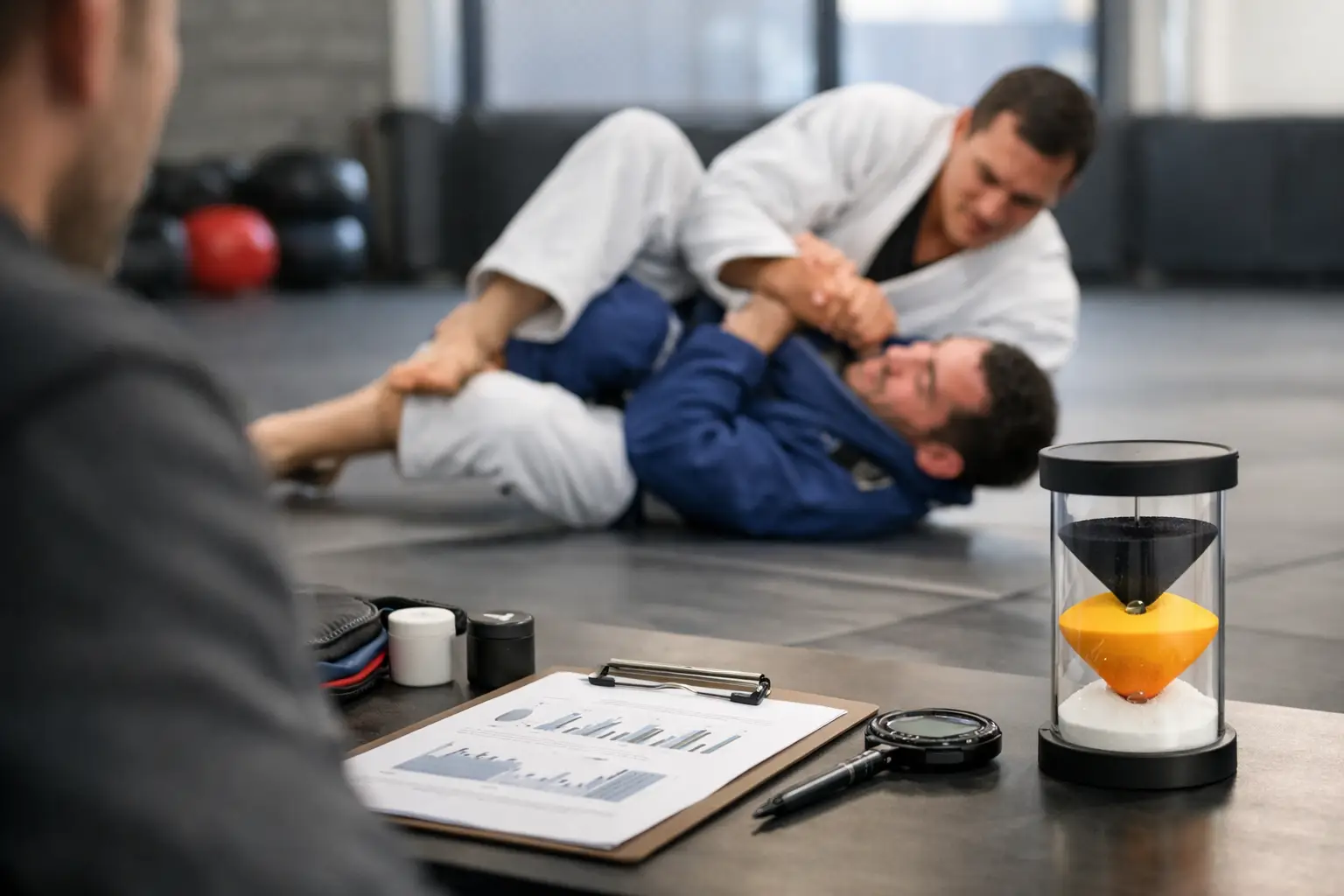
A hard sparring week is not the time to test a new squat max, add extra hill sprints, and wonder why your guard feels slow by Thursday. BJJ periodization training gives your off-mat work a job in each phase of the year. Instead of stacking random workouts beside class, it organizes strength, power, conditioning, and recovery around what you need to do better on the mat.
For a recreational grappler, that may mean training hard enough to build durable hips, shoulders, and grips without arriving exhausted to evening class. For a competitor, it means developing physical qualities well before the tournament, then narrowing training so you feel sharp rather than run down when the brackets start. The principle is the same: train with a sequence, not just with effort.
What BJJ Periodization Training Actually Solves
Brazilian Jiu-Jitsu has variable demands. One week may include five hard rounds after every class. The next may involve open mat, drilling, wrestling rounds, and a competition on Saturday. Your strength and conditioning cannot be effective if it ignores that changing load.
Periodization is the planned manipulation of training volume, intensity, exercise selection, and recovery over time. In BJJ, it helps prevent the common cycle of training hard in every area, accumulating fatigue, then losing consistency to nagging pain or burnout.
A periodized plan answers practical questions. When should you prioritize foundational strength? When does explosive power matter most? How much conditioning do you need if your academy already includes intense rolling? When should you reduce lifting volume because competition preparation is becoming more demanding?
The answer depends on your training age, injury history, class schedule, goals, and tolerance for total workload. A blue belt training three nights per week needs a different plan than a veteran competitor who wrestles, lifts, and rolls six days per week. The goal is not to make every athlete follow the same calendar. It is to give each athlete a structure that matches reality.
Build Physical Qualities in the Right Order
A useful BJJ strength-and-conditioning plan usually progresses from capacity to strength, then from strength to power and sport-specific conditioning. These phases overlap, but each one has a primary purpose.
Start With Movement Capacity and Tissue Resilience
Before chasing heavier lifts or more explosive movements, build the capacity to train consistently. This phase emphasizes joint control, mobility you can use under load, trunk strength, unilateral leg work, pulling strength, and gradual conditioning.
For grapplers, the payoff is straightforward. Better movement capacity supports stronger shots, more stable guard retention, safer scrambling, and greater tolerance for repetitive gripping and posting. It also creates room to increase training later without asking irritated knees, shoulders, or lower backs to absorb more than they can handle.
This is not a low-effort phase. It is where disciplined athletes earn the right to train harder. Use controlled reps, moderate loads, and exercise variations that fit your body. If a barbell back squat aggravates a hip, a split squat, belt squat, or loaded step-up may deliver the training effect with less cost.
Build Usable Strength
Strength is a force reserve. The stronger you are relative to your bodyweight, the less demanding many positions become. Standing up from guard, resisting a snap-down, finishing a single leg, maintaining posture in a front headlock, and applying pressure all benefit from higher force capacity.
During a strength-focused block, use compound movements and progressive overload while keeping enough energy for BJJ. Two focused lifting sessions per week can be highly effective for most practitioners. A third session may fit during lower-volume periods on the mat, but it is not automatically better.
Prioritize movements that transfer well to grappling demands: squats or split squats, hinges, presses, rows, pull-ups, carries, and anti-rotation trunk work. Grip training can be included, but avoid turning every session into a forearm destruction contest. Your hands also need to function in class.
The trade-off is fatigue. Heavy lower-body work can affect wrestling, guard passing, and scrambles for 24 to 72 hours, especially when you are not accustomed to it. Place demanding sessions away from your hardest rolling days when possible, and reduce accessory volume before you reduce the key lifts.
Convert Strength Into Explosive Power
BJJ is not a single maximal effort. It is a series of short, forceful actions repeated under fatigue: a level change, a bridge, a hip escape, a lift, a throw attempt, or a sudden scramble to the back. Power training helps you produce force faster.
Power work works best after you have established movement quality and a base of strength. It can include jumps, medicine ball throws, kettlebell swings, fast push-ups, and Olympic-lift derivatives if you have the skill and equipment. Keep reps low, intent high, and fatigue controlled. Five sloppy jump sets after a punishing conditioning circuit are not power training.
This phase does not require abandoning strength work. Instead, maintain strength with lower volume while adding explosive work early in sessions. If you compete in a ruleset with frequent takedown exchanges, power development may deserve a larger role. If your primary goal is general mat longevity, a smaller dose can still improve athleticism without taking over the plan.
Match Conditioning to Your Actual Mat Load
Many BJJ athletes make one of two mistakes. They do no conditioning outside of class, assuming rolling covers everything, or they add so much cardio that their legs are flat for technical training. Both approaches miss the point.
Rolling is specific, but its intensity is inconsistent. Some rounds are technical. Some are positional. Some become all-out battles. Structured conditioning fills gaps without replacing mat time.
Low-intensity aerobic work supports recovery between rounds, helps you tolerate more weekly training, and builds a base for harder intervals. Short high-intensity intervals can improve repeat-effort capacity for competition, but they carry a higher recovery cost. Use them deliberately, especially during a competition-focused phase.
A practical approach is to keep low-intensity conditioning in most phases and add higher-intensity work only when your BJJ schedule and recovery can support it. If you already roll hard four or five times per week, one targeted conditioning session may be enough. If you are in a technical training period with fewer live rounds, conditioning can take a more prominent role.
Adjust the Plan as Competition Approaches
Competition preparation is not the time to cram every physical quality into the same week. In the final weeks, your goal shifts from building to expressing. Keep strength and power exposures, but reduce unnecessary volume so fatigue does not hide the performance you built.
For many athletes, the last 7 to 14 days involve fewer total lifting sets, no unfamiliar exercises, and conditioning that supports sharpness without leaving heavy soreness. Exact timing depends on the athlete. A seasoned competitor may tolerate more work closer to the event than someone who tends to carry fatigue for several days.
After competition, do not immediately compensate for missed gym sessions with a punishing workout. Assess what hurts, restore movement, sleep, and nutrition, then return to a base-building phase. Long-term progress comes from stacking productive blocks, not from treating every Monday as a test of toughness.
Use Data, Not Guesswork
A periodized plan only works if it responds to feedback. Track your completed workouts, BJJ sessions, sleep quality, soreness, and performance markers such as rep strength, jump output, or conditioning pace. You do not need a lab to see trends. If your numbers are falling, your joints are irritated, and hard rounds feel worse for two weeks, your plan needs adjustment.
This is where personalized programming matters. MatFlow organizes BJJ-relevant strength and conditioning into structured phases while allowing workout adjustments, calisthenics alternatives, injury-aware exercise choices, and progress tracking. The goal is not to force a preset routine onto your week. It is to keep your physical preparation aligned with your mat training.
The best plan is not the most complicated one. It is the one you can execute consistently, adapt when life or training volume changes, and trust to make you more capable when the round gets hard. Build the right quality at the right time, recover with the same discipline you bring to class, and let your preparation show up when it matters.