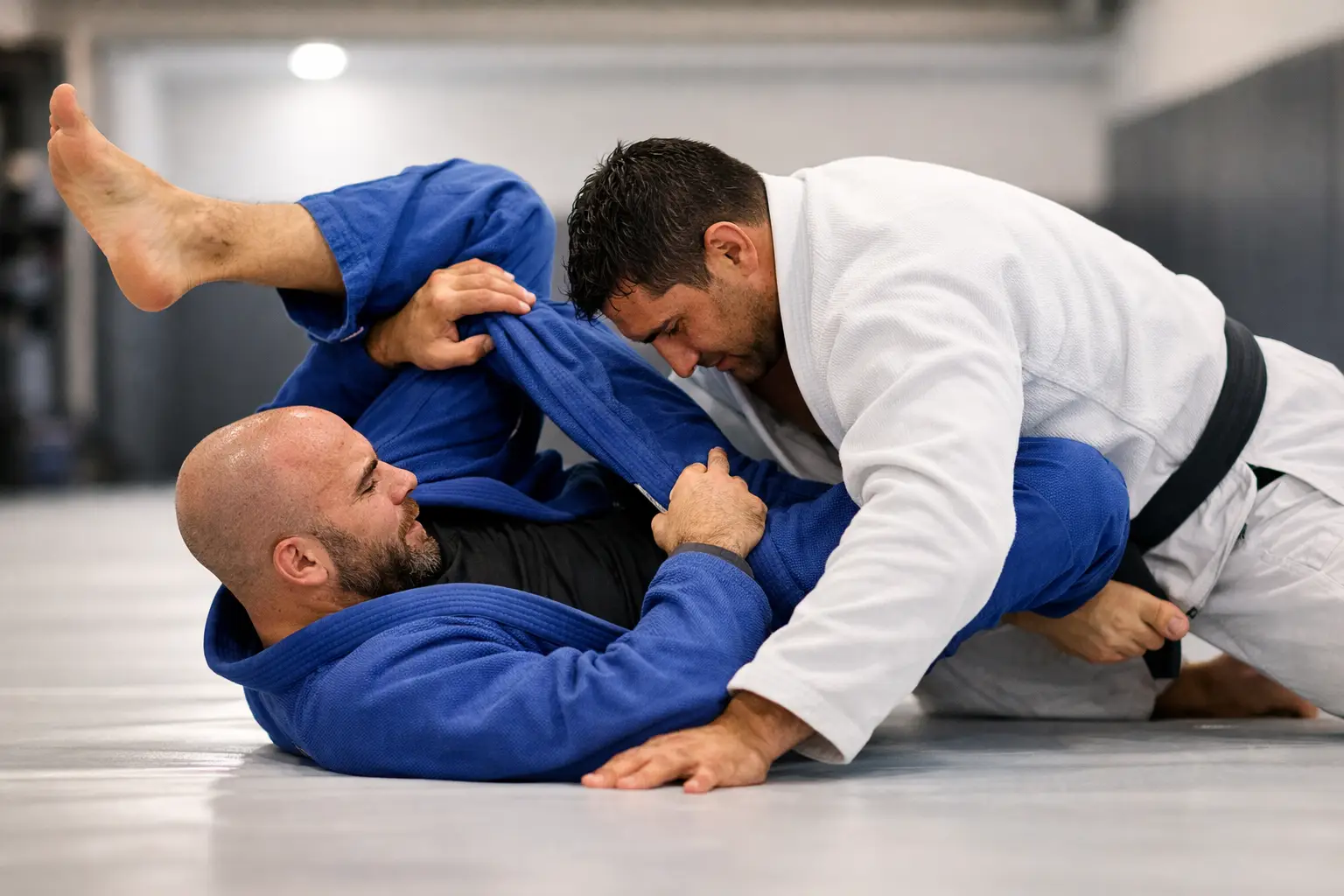
A tight hip is rarely just a tight hip in Brazilian Jiu-Jitsu. It can show up when your guard retention falls apart, when you cannot level change comfortably for a takedown, or when your lower back takes over during a scramble. Effective bjj mobility is not about collecting extreme stretches. It is about owning the positions your game demands, under fatigue and against resistance.
For grapplers, mobility has to work alongside strength, stability, and mat endurance. If you can pull your knee to your chest but cannot control that hip while framing, inverting, or standing up in base, the range is not doing enough for your jiu-jitsu. The goal is usable movement capacity that lets you train hard, recover well, and keep progressing without turning every class into a negotiation with sore joints.
What BJJ Mobility Actually Means
Mobility is active, controlled range of motion. Flexibility matters, but it is only one piece of the equation. A flexible hamstring does not automatically create a stronger open guard, and a loose shoulder is not necessarily a resilient shoulder.
BJJ mobility means you can move your joints through the ranges required by grappling while maintaining position, producing force, and responding to an opponent. It supports technical actions such as hip escapes, seated guard entries, leg pummeling, posting, bridging, sprawls, hand fighting, and overhead frames.
That distinction matters because passive stretching alone can create a false sense of preparation. Long holds may feel good after training, especially when you are stiff, but they do not teach your body to stabilize an end range. Strength work, controlled mobility drills, and time spent in specific positions do.
The right emphasis also depends on your body and game. A flexible guard player may need more hip control and adductor strength. A pressure passer with limited ankle motion may need better knee-over-toe capacity for low stances. A grappler returning from a shoulder issue needs carefully loaded shoulder range, not aggressive stretching because a video promised instant relief.
The Five Areas That Drive BJJ Mobility
Hips: Guard, Scrambles, and Level Changes
Hip mobility gets the most attention in jiu-jitsu for good reason. Your hips need flexion for guard retention, internal and external rotation for leg pummeling and transitions, and extension for bridging, sprawls, and powerful takedown finishes.
But hips are also where many athletes force range from the lower back. If your pelvis cannot control its position, you may compensate by rounding aggressively during guard work or overextending during bridges. Build active hip flexion, rotational control, and strength in deep positions instead of chasing a deeper stretch every day.
Useful work includes controlled 90/90 transitions, hip airplanes scaled to your balance, split-squat variations, and slow eccentric lateral lunges. These exercises challenge range while teaching you to own it. For guard players, loaded hip-flexor work and adductor strength deserve special attention because repeatedly lifting, framing, and recovering your legs is demanding.
Ankles: Better Base and Safer Knees
Ankle mobility is easy to overlook until your squat, wrestling stance, or technical stand-up feels restricted. Limited dorsiflexion often shifts stress upward. Your heels lift, your knees cave, your hips run out of options, and your back does extra work.
For BJJ, good ankle motion supports low passing stances, shots, sit-outs, standing guard passes, and stable base-building. It also helps you distribute force more effectively when you drive off the mat.
Train ankle mobility with controlled knee-over-toe movements, calf raises through a full range, and split-squat patterns. Avoid treating the ankle as a joint that only needs to be stretched. Your calves and feet must be strong enough to use the range during fast transitions and awkward posts.
Thoracic Spine: Rotation Without Losing Posture
Your thoracic spine is built to rotate. When it does not, rotation often comes from the lower back or shoulder instead. That can limit your ability to create angles from bottom position, maintain posture while pummeling, or turn through takedown and scrambling exchanges.
A mobile upper back helps you rotate while keeping your ribs and pelvis organized. Think of the difference between reaching for an underhook with a collapsed chest and rotating through the upper back with a strong frame.
Include controlled thoracic rotations, quadruped reach-throughs, and row variations that train scapular control. The key is not to force rotation by twisting the lower back. Keep the movement deliberate and make the upper back do its share of the work.
Shoulders: Strong Range for Posting and Framing
Shoulder mobility in BJJ is not a contest to see how far you can pull your arm behind your back. Your shoulders absorb posts, build frames, fight for underhooks, and resist uncomfortable positions when opponents isolate your arms.
Healthy shoulder mobility requires coordinated movement from the shoulder joint, shoulder blade, upper back, and rib cage. If one part is restricted or weak, another part often compensates. That is why random band work is rarely enough for a grappler with recurring shoulder irritation.
Use controlled pressing and pulling, carries, hanging progressions if tolerated, and rotator cuff work with purpose. Prioritize smooth overhead motion, stable scapular movement, and strength in the positions you repeatedly use. If a drill produces sharp pain, numbness, or symptoms that linger, adjust it rather than pushing through.
Adductors and Hamstrings: The Hidden Guard Muscles
Your inner thighs and hamstrings work constantly in jiu-jitsu. They help you clamp, retain guard, change angles, and control your opponent's hips. They also take substantial stress during wide passing positions, sprawls, and sudden scrambles.
This is why passive groin stretching is not enough. Build capacity through Copenhagen plank progressions, lateral lunges, controlled hamstring eccentrics, and long-range bridges. Start with a range you can control. Forcing a deep position before your tissues are ready is a fast way to make the next training session worse.
How to Build a BJJ Mobility Routine That Works
The best mobility plan is the one that fits around your mat schedule. A 45-minute session is useful when it serves a clear purpose, but most recreational grapplers will get more consistent results from short, targeted sessions performed several times per week.
Before class, use mobility to prepare positions. Choose active drills that raise temperature, move your joints, and rehearse the ranges you expect to use. Two or three rounds of hip transitions, ankle rocks, thoracic rotations, and controlled shoulder circles can be enough. Do not turn pre-class mobility into a draining flexibility workout.
After class or on separate strength days, use longer-range strength work. This is where split squats, lateral lunges, loaded carries, deep squats, and controlled end-range exercises create lasting change. The load should be challenging enough to build adaptation without leaving your joints wrecked for hard sparring.
A simple weekly structure can look like this:
- Before two to four BJJ sessions, spend 8 to 12 minutes on active hip, ankle, upper-back, and shoulder preparation.
- During two strength sessions, include two or three loaded mobility exercises that match your current restrictions and goals.
- On one lower-intensity recovery day, use 15 to 20 minutes of controlled range work, breathing, and easy movement rather than forcing deep stretches.
- Reassess every few weeks based on your training experience: better guard retention, smoother stand-ups, less joint irritation, or improved comfort in specific positions.
The exact volume depends on your class frequency, age, injury history, and competition phase. During a hard competition block, maintenance is often enough. In an off-season or a lower-volume phase, you can invest more in building range and strength at that range.
Mobility Should Not Compete With Strength Training
A common mistake is separating mobility from performance training. Grapplers do a few stretches because they feel stiff, then lift with shortened ranges and wonder why nothing changes. Mobility improves more reliably when it is built into the strength plan.
For example, a deep split squat can improve hip and ankle options while building single-leg strength for takedowns and base. A controlled lateral lunge develops adductors while improving your ability to load a wide stance. A hanging progression can support shoulder motion and grip endurance when it is appropriate for your shoulders.
This is where individualized programming matters. The same exercise may be productive for one athlete and aggravating for another. MatFlow organizes strength, mobility, and recovery work around your BJJ schedule, available equipment, training phase, and injury limitations, so your off-mat work supports your time on the mat instead of competing with it.
Measure Mobility by What Changes in Training
Do not judge progress only by a photo of a deeper squat or a wider pancake. Those benchmarks can be useful, but BJJ-specific markers matter more. Notice whether you can maintain better posture in closed guard, recover your feet inside more consistently, shoot without hesitation, or finish rounds with less stiffness in your hips and back.
Track discomfort honestly as well. Mobility work should create manageable training stress, not increase symptoms session after session. If a joint stays painful, feels unstable, or loses range unexpectedly, get a qualified clinician involved. Smart training includes knowing when a limitation needs assessment rather than another drill.
Train the ranges your jiu-jitsu repeatedly asks for, then build enough strength to trust them when the round gets chaotic. That is the kind of mobility that keeps you available for more training, more development, and better performance on the mat.