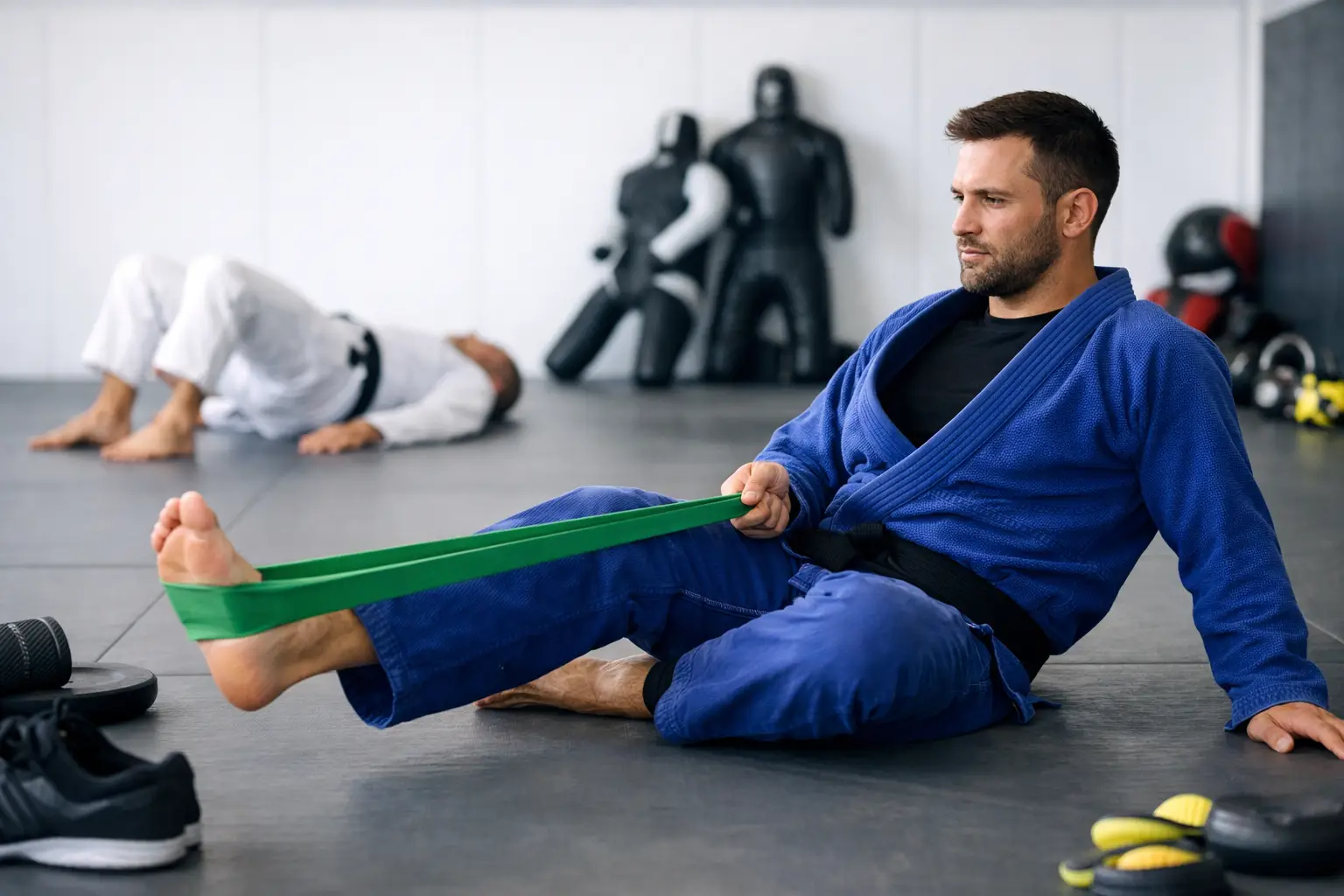
A hard round rarely causes trouble because of one movement. Problems usually build when your shoulders absorb repeated posting, your knees twist under fatigue, or your neck and grip are asked to work hard without enough strength reserve. The right BJJ injury prevention exercises do not make grappling risk-free. They give your joints, tissues, and movement patterns more capacity to handle the demands of training.
For most grapplers, the goal is not to spend an hour doing corrective work before class. It is to build a repeatable strength and mobility system that improves explosive power, mat endurance, and recovery while addressing the areas BJJ tests most often: shoulders, neck, hips, knees, hands, and trunk.
How BJJ Injury Prevention Exercises Build Durable Athletes
Injury prevention is not a collection of magic drills. It is the practice of matching your physical preparation to the forces you encounter on the mat. Frames load the shoulders. Guard retention challenges hip rotation and trunk control. Takedowns and scrambles demand knee stability, single-leg strength, and the ability to decelerate. Long rounds expose weak links once fatigue changes your mechanics.
The most useful training improves three qualities at once: usable range of motion, strength through that range, and control under load. Passive stretching may help you feel less restricted, but it does not prepare a shoulder to post during a scramble. Heavy lifting develops force, but it needs to be paired with positions that look enough like the demands of grappling.
That is why a complete plan uses controlled strength work, loaded carries, unilateral exercises, and targeted mobility rather than relying on random band routines. The exercise itself matters, but dosage matters just as much. A great drill becomes a poor choice when it adds fatigue you cannot recover from around hard sparring.
Build Shoulder and Neck Resilience
Shoulder issues are common in BJJ because the joint is exposed in extended, rotated, and loaded positions. Your preparation should develop the rotator cuff, shoulder blade control, pulling strength, and pressing strength without constantly training into painful ranges.
Train the Rotator Cuff With Control
Cable or band external rotations are useful when performed slowly, with the elbow positioned at your side or supported at shoulder height. Keep the shoulder blade stable rather than cranking the arm backward. Two to three sets of 10 to 15 controlled reps after your main strength work is usually enough.
Pair that with face pulls or band pull-aparts. These are not substitutes for full-body pulling, but they reinforce the upper-back strength that helps you maintain better posture when hand fighting, framing, and fighting grips.
Use Carries for Stronger Frames
Suitcase carries and farmer carries train the shoulder, grip, and trunk as a single unit. Walk tall, keep your ribs stacked over your pelvis, and avoid leaning toward the weight. A suitcase carry is especially valuable because it challenges the side of the trunk that prevents you from folding or twisting under pressure.
Three carries of 20 to 40 yards per side can deliver more transferable shoulder stability than adding another high-rep isolation circuit. Start lighter than you think. The goal is position quality, not surviving the walk.
Strengthen the Neck Without Chasing Fatigue
A stronger neck can help you tolerate collar ties, crossfaces, and the constant isometric work of grappling. Begin with gentle isometrics: press your head into your hand, a wall, or a band in each direction without moving your neck. Build from 10-second holds to 20- or 30-second holds.
Neck bridges are not mandatory. They can be appropriate for experienced athletes with healthy necks and sound progression, but they are not the first option for a grappler with recurring neck pain, headaches, or nerve symptoms. In that situation, reduce aggravating training and get assessed by a qualified clinician.
Protect Knees and Hips With Single-Leg Strength
Knees often take the blame when the real issue starts above or below them. Limited hip control, weak adductors, poor foot strength, and rushed changes of direction can all make a knee less prepared for guard exchanges, shots, and awkward scrambles.
Split Squats Build Control Where BJJ Needs It
The rear-foot-elevated split squat is one of the best BJJ injury prevention exercises because it trains each leg independently through a meaningful range. It develops the quads and glutes while asking the pelvis and knee to stay organized.
Use a range you can control without pain. Let the front knee travel naturally over the toes if your heel stays grounded and the movement feels stable. Three sets of six to 10 reps per side, once or twice a week, creates a strong foundation without excessive volume.
Add Lateral and Adductor Work
BJJ is not a straight-line sport. Lateral lunges and Cossack squat variations build strength in side-to-side positions that show up during passing, base recovery, and open-guard movement. Copenhagen planks add direct adductor strength, which can be valuable for athletes who regularly experience groin tightness or feel unstable when squeezing and posting with the legs.
Start Copenhagen planks with a bent lower knee supported on a bench. Short holds of 10 to 20 seconds are enough at first. Groin tissue responds well to progressive loading, not aggressive stretching before it is ready.
Do Not Skip Calf and Foot Strength
Your feet and calves help manage force every time you shoot, sprawl, stand up, or change direction. Controlled single-leg calf raises improve ankle strength and can support healthier knee mechanics. Use a full range, pause at the top, and lower slowly for eight to 15 reps.
Train the Trunk for Guard Retention and Safer Scrambles
A durable trunk does more than produce visible abs. It transfers force between the hips and shoulders, resists unwanted rotation, and helps you maintain posture when someone is pulling, twisting, or compressing you.
Dead bugs are a strong starting point because they teach you to move the hips and shoulders while keeping the rib cage and pelvis connected. Progress by slowing the lowering phase or adding a band pulldown. Pallof presses train anti-rotation and fit well after lower-body strength work.
For more advanced athletes, hanging knee raises and controlled toes-to-bar variations can build the hip-flexor and trunk strength used in guard retention. The trade-off is that they can irritate the front of the hip or shoulder if you rush volume. Keep the range clean and avoid turning every set into a grip endurance test.
Program Your Work Around Mat Training
The best exercise selection fails when it ignores your weekly BJJ load. If you train hard five or six days per week, your injury prevention work should be concise and repeatable. Two focused strength sessions, plus five to 10 minutes of targeted warm-up work before class, is enough for many recreational grapplers.
On a high-intensity sparring day, prioritize low-fatigue preparation: shoulder rotations, hip mobility, neck isometrics, and a few controlled bodyweight patterns. Save challenging split squats, carries, and heavy pulling for days when you can recover.
A useful rule is to finish most sets with one to three good reps still available. Training to failure can have a place, but it is rarely necessary for accessory work intended to keep you on the mats. If your elbows, shoulders, or knees feel progressively worse for several sessions, reduce volume, adjust the range, or choose a variation that fits your current limitation.
Turn Prevention Into a Measurable System
Consistency beats occasional marathon prehab sessions. Track the loads, reps, holds, and pain response for your key movements. If suitcase carries get heavier, split squats become more stable, and your neck isometrics improve without symptoms, you have evidence that capacity is moving in the right direction.
This is where individualized programming matters. A competitor preparing for a tournament may need shorter, lower-volume sessions that preserve explosive power. A newer grappler with limited training history may benefit from building foundational strength before adding more advanced mobility drills. MatFlow organizes those decisions around your BJJ schedule, training phase, movement limitations, and progress rather than treating injury prevention as an isolated workout.
Train hard when the plan calls for it, but make room for the work that lets you keep training next month and next year. Durable grapplers are built through smart exposure, steady progression, and enough respect for recovery to return to the mat ready for the next round.