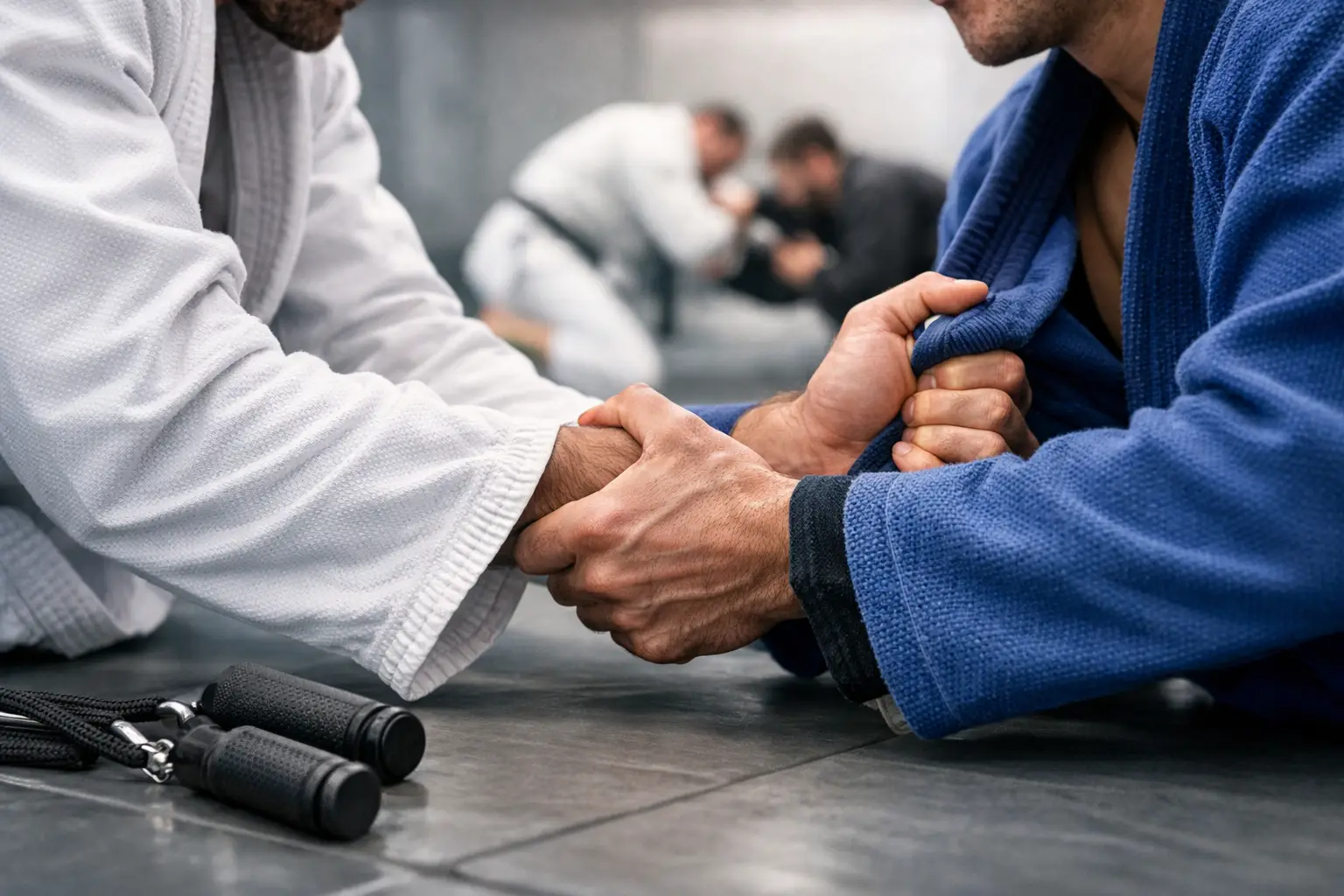
A grip that fades halfway through a hard round changes your whole game. You stop threatening collar attacks, lose connection during passing exchanges, and spend more energy trying to re-grip positions you should already control. BJJ grip strength is not about winning a hand-squeeze contest. It is the ability to create, maintain, release, and recover grips under the changing demands of live grappling.
For most athletes, the answer is not simply doing more grippers. Better on-mat grip performance comes from training the hands, wrists, forearms, elbows, shoulders, and upper back as one connected system. It also comes from placing that work where it supports your jiu-jitsu instead of making your next class feel like a fight with your own forearms.
What BJJ Grip Strength Actually Requires
A strong grip in Brazilian Jiu-Jitsu has several jobs. You need crush strength to close your hand around a sleeve, lapel, wrist, or collar. You need support strength to hold that connection while your opponent pulls, frames, and changes direction. You need pinch strength for no-gi wrist control and certain gi grips. Just as importantly, you need finger extension and wrist stability to keep the tissues around the hand and elbow healthy.
The most sport-specific quality is endurance under tension. A deadlift asks your hands to hold once. A round of BJJ asks you to grip, relax, re-grip, pull, post, frame, and defend repeatedly while your heart rate is elevated. That is why someone can have a respectable deadlift but still feel their forearms pump out during hard gi rounds.
Your style also matters. A gi player who builds collar-and-sleeve sequences needs more tolerance for sustained finger flexion. A no-gi athlete may benefit more from wrist control, pulling endurance, and the ability to connect hands during body locks. Competitors who wrestle up often need strong hands that can transfer force through the wrist and elbow without breaking position.
Train the Whole Grip System, Not Just Your Fingers
Grip work should reinforce the bigger pulling patterns that already carry over to grappling. Rows, pull-ups, dead hangs, loaded carries, and deadlifts teach the hand to transmit force through the arm and trunk. They are valuable because grips rarely operate in isolation on the mat.
A towel pull-up or gi-over-bar pull-up can be useful, but only if your shoulders tolerate it and you can control the volume. These variations increase the demand on your fingers while still training vertical pulling. Start with assisted reps, slow negatives, or timed hangs if full reps are not yet clean.
Loaded carries are another high-return option. Farmer carries build support strength, trunk stiffness, and shoulder positioning while forcing you to maintain a secure hand position under fatigue. Suitcase carries add an anti-rotation demand that transfers well to resisting pulls and maintaining posture in standing exchanges.
For more direct forearm work, use targeted movements rather than endless random drills. Wrist extension, wrist flexion, pronation, supination, and finger extension can build capacity around the wrist and elbow. These are not flashy exercises, but they help balance the repeated gripping and pulling that can otherwise lead to irritated elbows and stiff hands.
A productive grip-focused session might include four elements:
- A heavy carry or pull for support strength
- A hanging or towel-based movement for sport-specific endurance
- Wrist rotation or extension work for joint resilience
- Finger extension work to balance high-volume gripping
You do not need to push every element to failure. The goal is to leave the gym more prepared for the mat, not too fatigued to train your actual sport.
Build BJJ Grip Strength With the Right Progression
Progression matters more than novelty. Start by choosing one primary grip exposure and one or two smaller accessory movements each week. For example, you might use farmer carries as your primary movement, then add wrist extensions and band finger opens after your main strength work.
Once that feels sustainable, progress one variable at a time. Add load to carries, increase the distance, extend a hang by a few seconds, or add a set. Avoid adding weight, sets, frequency, and intensity in the same week. Your forearm flexors and elbow tendons adapt more slowly than your motivation after a great training session.
For pure strength, shorter efforts work well. Heavy carries of 20 to 40 seconds, or challenging hangs of 10 to 30 seconds, allow you to train force without turning every set into a burn-out test. For endurance, use longer timed holds, repeated submaximal hangs, or circuits that keep the grip working while the rest of the body moves.
A practical progression could look like this: build a base of two weekly exposures for four to six weeks, then increase one exercise or add a short third exposure if your hands and elbows feel good. During a competition phase, reduce extra grip volume rather than trying to create a last-minute strength gain. Your BJJ sessions already provide a significant grip workload, especially in the gi.
Put Grip Training Around Your Mat Schedule
The best grip program is one that respects your hardest rolling days. If you have intense gi sparring on Tuesday and Thursday, avoid a high-volume grip session the night before. Train heavier grip work after a lower-intensity class, after a no-gi session, or on a separate strength day with enough recovery before your next demanding round.
For many recreational athletes, two intentional grip exposures per week are enough. One can be integrated into a full-body strength session through carries, rows, and pull-ups. The other can be a brief 10 to 15 minute capacity block built around hangs, wrist work, and finger extension.
If you train BJJ five or six days per week, less direct grip work may produce better results. Your limiting factor may be recovery, not effort. In that case, prioritize heavy compound pulls, maintain some extensor work, and let live grappling provide much of the endurance stimulus.
This is where individualized programming matters. MatFlow organizes strength phases, exercise alternatives, and training volume around your BJJ schedule, so your grip work supports performance without ignoring sore elbows, limited equipment, or a demanding competition week.
Do Not Train Through Tendon Pain
Normal forearm fatigue is part of training. Sharp pain, persistent tenderness at the inside or outside of the elbow, numbness, or a grip that feels weaker week after week is a signal to adjust. More gripping is not always the solution.
First, reduce the most provocative movement. That may mean replacing towel hangs with standard bar hangs, lowering carry loads, or using straps temporarily for heavy pulling so the rest of your posterior-chain training can continue. Then add controlled wrist extension, pronation, supination, and finger-opening work within a tolerable range.
Grip health also depends on technique. Death-gripping every collar exchange is expensive. Learn when to connect, when to switch grips, and when to release before your opponent strips the grip anyway. Efficient grapplers do not hold everything at maximum tension. They apply force with purpose.
Make Your Grip Training Show Up in Rounds
The clearest test is not whether you can close a harder gripper. It is whether you can keep effective connections late in rounds, control posture without burning out, and recover your hands between training days.
Choose exercises that match your current needs, progress them patiently, and track how your hands and elbows respond alongside your mat performance. A stronger grip should give you more options, not more pain. Build it with the same discipline you bring to your technique, and it will become a reliable part of your game when the round gets hard.