A good bjj competition training plan should make you sharper when the match gets chaotic, not so fatigued that your best jiu-jitsu disappears before you reach the bracket. The goal is not to cram in more workouts. It is to organize your strength, conditioning, sparring, and recovery around the physical demands of your tournament date.
Competition exposes the gaps that regular training can hide. You may feel technically sound in class, then struggle to maintain posture during a hard hand fight, recover after an extended scramble, or generate force late in a match. Your off-mat work should target those moments with a plan that builds explosive power, mat endurance, resilient joints, and confidence in your conditioning.
Build Your BJJ Competition Training Plan Around the Date
Start by counting backward from competition day. Most grapplers benefit from an 8- to 12-week preparation block, but the right timeline depends on your training age, current conditioning, injury history, and how often you are already training jiu-jitsu. An experienced athlete who trains five times a week may need less added volume than a recreational blue belt returning after time away.
The plan should change as the event approaches. Early weeks develop the physical qualities you need. Middle weeks turn those qualities into competition-specific output. Final weeks reduce fatigue while preserving speed, strength, and confidence.
Do not treat every week as a test. Hard rolls, lifting PRs, sprint sessions, and aggressive calorie cuts all create stress. Put them together without structure and your body will usually respond with declining performance, sore joints, poor sleep, or an injury that disrupts the entire camp.
Phase 1: Build the base
The first phase usually lasts three to four weeks. Its job is to strengthen the foundation that lets you train hard later: lower-body strength for takedowns and base, upper-body pulling strength for grips and posture, trunk control for guard work, and tissue capacity for shoulders, knees, hips, and elbows.
Prioritize controlled strength work two or three days per week. Squat or split-squat patterns, hinge patterns, rows, pull-ups, presses, loaded carries, and anti-rotation trunk work cover a great deal of what grapplers need. The exercise selection matters, but so does your ability to perform it consistently. If a barbell back squat irritates your hip, a front squat, goblet squat, split squat, or sled variation may be the smarter option.
Keep conditioning mostly aerobic during this phase. Zone 2 work on a bike, rower, incline treadmill, or easy run improves your ability to recover between hard exchanges and training sessions. It should feel sustainable, not like a second sparring session.
Phase 2: Convert strength into mat output
With four to six weeks remaining, shift more attention toward rate of force development and repeatable high-intensity effort. You are not abandoning strength. You are using it more purposefully.
Add low-volume explosive work before your primary lifts, when you are fresh. Broad jumps, medicine ball throws, kettlebell swings, and explosive push-ups can help develop force without turning the session into a long conditioning circuit. Choose movements you can perform crisply. Explosive training done while exhausted is usually just sloppy training.
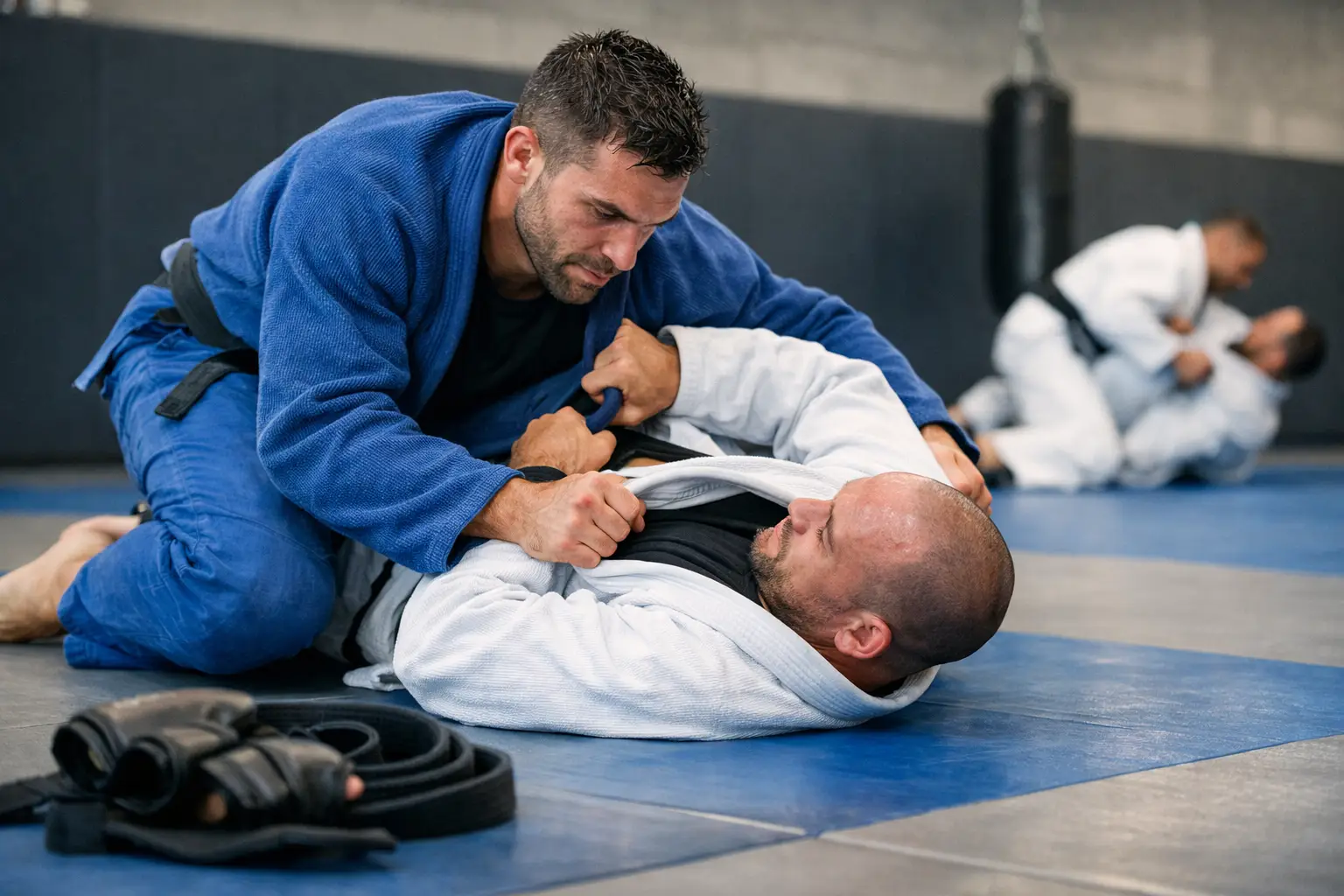
This is also the time to make sparring more intentional. Build some rounds around the ruleset, match length, scoring patterns, and pace you expect at the event. Start rounds from your highest-value positions, but also include bad-position starts. If you tend to lose the first grip exchange or get flattened in half guard, address it while your training partners are fresh and resistant.
Conditioning can become more specific here, but it should not duplicate hard rolling. One focused interval session per week is often enough when you are already sparring intensely. For example, use repeated efforts that match the work-to-rest rhythm of your division, then recover fully enough to maintain quality across sets. The aim is repeatable output, not exhaustion for its own sake.
Balance Lifting, Rolling, and Recovery
Your weekly schedule should reflect your actual mat load. A competitor rolling hard four days per week does not need four additional hard gym sessions. More work is not automatically more preparation.
For many adult competitors, two full-body strength sessions are enough during a camp. Place them away from your hardest sparring days when possible. If your academy's competition class is Tuesday and Thursday night, lifting Monday and Friday may work better than stacking heavy lower-body work immediately before those sessions.
A simple week might include two strength sessions, one low-intensity aerobic session, one short interval session, two competition-focused sparring sessions, and one or two technical sessions. That structure is not universal. If you train BJJ six days per week, conditioning may need to be reduced. If you can only make class three times per week, carefully planned conditioning becomes more valuable.
Track the signals that matter. Session performance, resting soreness, sleep quality, grip and joint irritation, and motivation are all useful feedback. A flat week can happen. Several flat sessions in a row usually mean the plan needs adjustment.
MatFlow helps organize these decisions with BJJ-specific training phases, personalized session options, exercise alternatives, and progress tracking. That matters when a busy work week, a sore shoulder, or extra sparring changes what your body can realistically recover from.
Protect the joints you rely on
Competition camps often expose athletes to more intense gripping, wrestling, and awkward ranges of motion than usual. Shoulder, neck, knee, elbow, and finger management should be part of the plan from day one, not an afterthought when pain forces you to stop.
Use intelligent substitutions early. If your elbows are irritated from heavy gi gripping, reduce unnecessary high-volume pulling and use neutral-grip options or lower-grip-demand exercises. If your knees are sensitive, prioritize controlled single-leg strength, posterior-chain work, and movement patterns you can load without pain. Injury-aware training does not mean avoiding effort. It means directing effort toward adaptations your body can tolerate.
Mobility also needs a practical purpose. You do not need endless stretching sessions. Build usable range in the hips, ankles, thoracic spine, and shoulders, then strengthen that range. A deeper squat or more stable overhead position only helps if you can control it under fatigue.
Taper Without Feeling Flat
The final seven to 10 days should reduce accumulated fatigue, not eliminate all training. Many competitors make one of two mistakes: they keep pushing hard until weigh-ins, or they stop moving completely and feel slow on the mat.
Keep some intensity while reducing volume. You can perform lighter strength sessions with a few fast, clean sets. You can drill at competition pace and do short positional rounds without turning every class into a war. The goal is to arrive with your nervous system awake, your joints calm, and your gas tank full.
Avoid adding new exercises, changing your diet dramatically, or chasing a last-minute conditioning breakthrough during taper week. If you are cutting weight, the margin for error gets smaller. Your training volume, hydration, sleep, and food choices need to support the cut rather than compete with it. Aggressive dehydration can cost the exact endurance and decision-making you spent the camp building.
Make Competition Day Familiar
Preparation should reduce decisions on tournament day. Know your warm-up sequence, your first-match routine, your preferred opening exchanges, and how you will reset after a tough round. Have a simple physical warm-up that raises temperature, mobilizes the positions you use, and includes a few explosive movements without draining energy.
Your plan should also include a realistic expectation: competition is stressful, and adrenaline changes pacing. The athlete who wins the first scramble is not always the athlete who manages the match best. Trust the work you have done, breathe between exchanges, and use the conditioning you built to make disciplined decisions late in the round.
The strongest competition camp is not the one that leaves you most exhausted in training. It is the one that puts you on the mat prepared to impose your game, recover under pressure, and perform when the match finally matters.