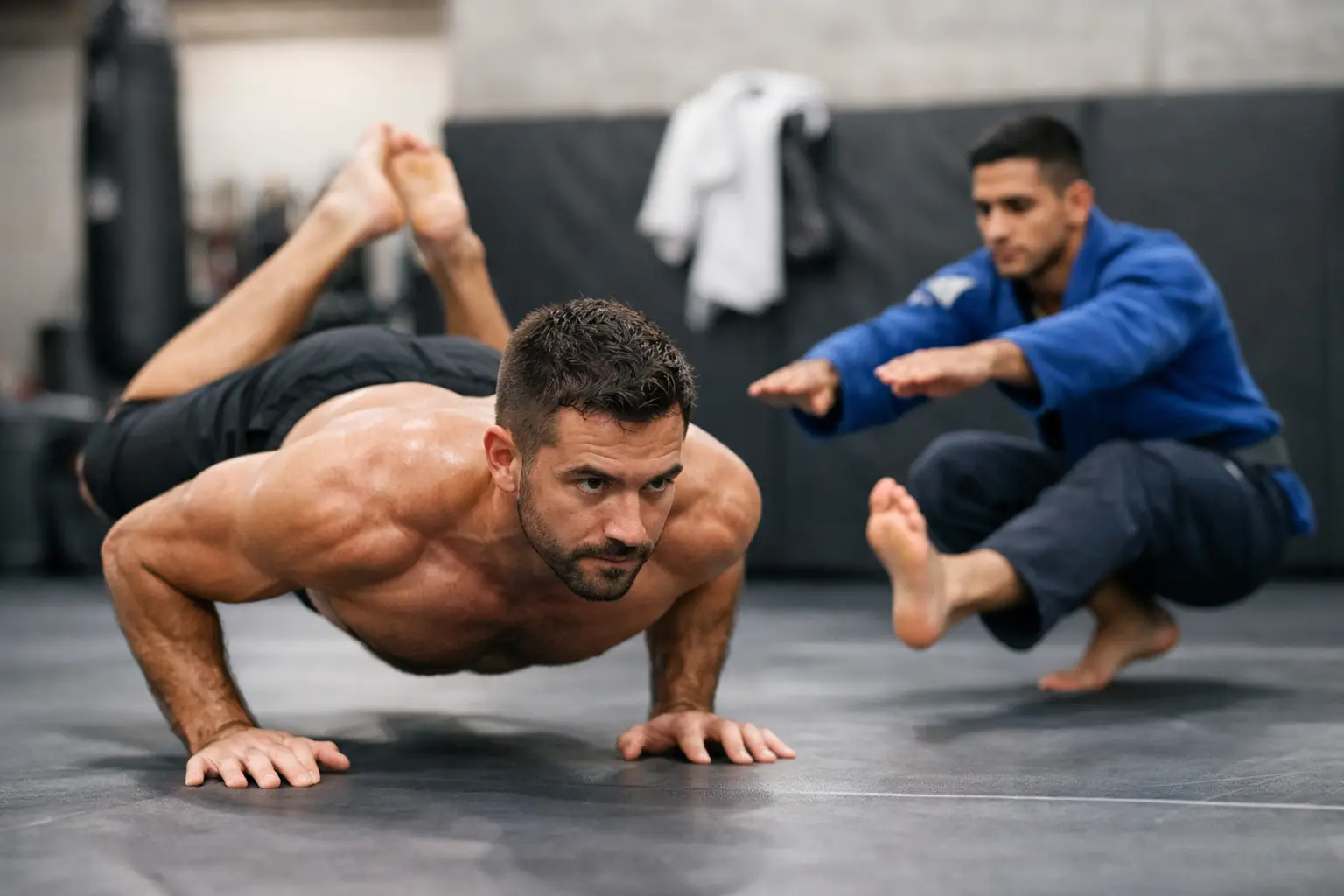
A hard round exposes weak links fast. Your grips fade during a collar tie, your posture breaks when someone stacks your guard, or your hips feel slow during the third scramble. BJJ calisthenics can address those problems without turning your off-mat work into another exhausting sport. Done with structure, bodyweight training develops the pulling strength, positional control, joint capacity, and conditioning that carry over to grappling.
The key is not collecting impressive exercises. A strict muscle-up may be a great personal milestone, but it is not automatically the best use of training time for every grappler. Productive calisthenics for BJJ starts with the physical qualities your game and training schedule actually demand.
What BJJ Calisthenics Should Build
Brazilian Jiu-Jitsu rewards athletes who can produce force from awkward positions, hold tension while breathing under pressure, and repeatedly recover between intense efforts. Your calisthenics work should support those demands rather than chase fatigue for its own sake.
Upper-body pulling strength is a clear priority. Strong lats, upper back, elbows, and hands help you maintain posture in clinches, control distance from guard, finish takedowns, and resist being pulled out of position. Pull-ups, chin-ups, rows, and controlled hanging variations build that foundation when progressed appropriately.
Just as important is shoulder integrity. BJJ puts the shoulder through loaded end ranges during posting, framing, underhook battles, and escapes. Push-ups, scapular push-ups, pike push-ups, and carefully selected dip variations can strengthen pressing patterns, but the goal is stable, pain-free shoulders, not simply more repetitions.
Your trunk and hips connect everything. A grappler needs more than the ability to hold a long plank. You need to brace while someone drags your hips, rotate during a sit-out, flex and extend under control, and resist rotation when passing or defending a sweep. Dead bugs, hollow-body variations, side planks, hanging knee raises, bridges, and single-leg work all have a place because they train force transfer and body control.
Train Patterns, Not Random Exercises
A useful BJJ calisthenics plan covers a few core movement patterns each week: pull, push, squat or single-leg work, hip extension, trunk control, and locomotion or conditioning. This does not mean every session needs every pattern. It means your overall plan should not leave obvious gaps.
For pulling, start with the variation you can control. That may mean ring rows, feet-assisted pull-ups, or slow eccentric chin-ups before full pull-ups. A clean set of five chin-ups with a brief pause at the top is more valuable than ten rushed reps with shrugged shoulders and swinging legs.
For pushing, push-ups are a reliable starting point because they allow the shoulder blades to move naturally. Elevate your hands if standard push-ups cause compensation, or elevate your feet and add a pause at the bottom once regular reps are easy. Dips can build strength, but they are not mandatory. If your shoulders feel irritated after hard rolling, deep dips may create more stress than benefit.
For lower body, split squats, reverse lunges, step-ups, shrimp squats, and single-leg squats develop leg strength with minimal equipment. Hip bridges and hamstring walkouts add posterior-chain work that helps with bridging, lifting, and maintaining strong hip extension. Slow eccentrics are especially useful when bodyweight alone is not challenging enough.
Do not ignore hanging and crawling. Dead hangs can build grip tolerance and shoulder awareness, provided they are comfortable for your shoulders. Bear crawls, crab walks, and controlled ground locomotion develop coordination, shoulder stability, and the ability to move your body through space - qualities that show up constantly in scrambles.
Progress With Leverage, Tempo, and Range
Bodyweight training is not limited to adding reps forever. Once an exercise becomes easy, you can make it harder by changing leverage, extending range of motion, slowing the lowering phase, pausing in difficult positions, or adding external load when appropriate.
For example, progress a row by moving your feet farther forward, then add a two-second pause with your chest close to the handles. Progress a push-up with a longer eccentric before moving to feet elevation. Progress a split squat by increasing depth and control before chasing high-rep burnouts.
This approach matters because grapplers need strength they can express under control. Fast, sloppy repetitions may raise your heart rate, but they do little to improve the positions where you must stay organized against resistance.
Build Strength Without Ruining Your Rolling
The most common error is treating calisthenics as a separate punishment session. If you train BJJ four or five days per week, add high-volume push-ups, pull-ups, burpees, and jump squats every day, something usually gives: your elbows ache, your shoulders tighten, or your sparring quality drops.
For most committed recreational grapplers, two focused strength sessions per week are enough to make consistent progress. Sessions can run 30 to 45 minutes and should leave you trained, not wrecked. Competitive athletes may use three sessions during a general preparation phase, then reduce volume as competition-specific mat intensity climbs.
Place harder strength sessions away from your toughest rolling when possible. If Tuesday is heavy takedown work and hard rounds, Monday may be better for a controlled lower-body and trunk session than a high-volume pulling workout. If your academy schedule forces sessions together, reduce the strength volume and keep two or three reps in reserve.
A simple session might pair a pull-up variation with split squats, then push-ups with bridges, followed by a trunk-control drill. Use three to five quality sets per main movement, with rest long enough to preserve technique. Conditioning circuits have value, but they should be used intentionally, not as the default finish to every workout.
Calisthenics Conditioning for Mat Endurance
Mat endurance is not just cardio. It is the ability to maintain technical movement and composure while your forearms, trunk, hips, and lungs are all working. Calisthenics can help, particularly when you use intervals that resemble the repeated efforts of grappling.
Short circuits of crawling, sprawls, push-ups, squat variations, and hanging can build work capacity with little equipment. But exercise choice and volume need to match your current capacity. A beginner who cannot yet perform stable push-ups does not need an aggressive 20-minute burpee circuit. They need movement quality, gradual exposure, and enough recovery to return to class ready to learn.
For more experienced athletes, use controlled rounds rather than chaotic AMRAP sessions. Work for 30 to 60 seconds, rest briefly, and repeat with a standard you can maintain. Stop the set when posture, shoulder position, or landing mechanics deteriorate. Conditioning should reinforce athletic movement, not teach your body to move poorly while tired.
Adjust for Injuries and High-Volume Weeks
BJJ athletes rarely train under perfect conditions. A sore elbow from grip fighting, a cranky knee after passing drills, or a stiff shoulder can change what makes sense that week. The right adjustment is rarely doing nothing forever, and it is rarely pushing through sharp pain.
If your elbows are aggravated, reduce high-volume hanging and aggressive pulling eccentrics. Use a more comfortable row angle, limit range if needed, and emphasize pain-free tempo. If knees are irritated, swap jump-heavy work for controlled split squats, bridges, or isometric holds. If your shoulder does not tolerate dips or deep push-up positions, choose an elevated push-up and add scapular control work instead.
This is where generic workout templates fail grapplers. Your training must respond to mat volume, current limitations, and the physical qualities you need most. MatFlow organizes calisthenics alternatives, training phases, and injury-aware adjustments around those variables, so your program can evolve without losing direction.
Measure What Carries Over
Track more than a max-rep test. Record clean pull-ups, controlled push-up volume, single-leg strength, hang tolerance, and how your body feels across hard training weeks. Then compare those numbers with relevant mat outcomes: Can you hold posture longer? Do you recover better between rounds? Are your shoulders and elbows less reactive after training?
Progress in BJJ is rarely linear, and your conditioning should account for that. A week of heavy sparring may call for maintenance. A lower-volume period may be the right time to build strength more aggressively. The athlete who adjusts intelligently will usually outlast the athlete who treats every week like a test.
Build a small number of movements you can perform well, progress them patiently, and keep enough energy to train your jiu-jitsu with purpose. Stronger movement off the mat should make you more capable on it - not too sore to show up.